
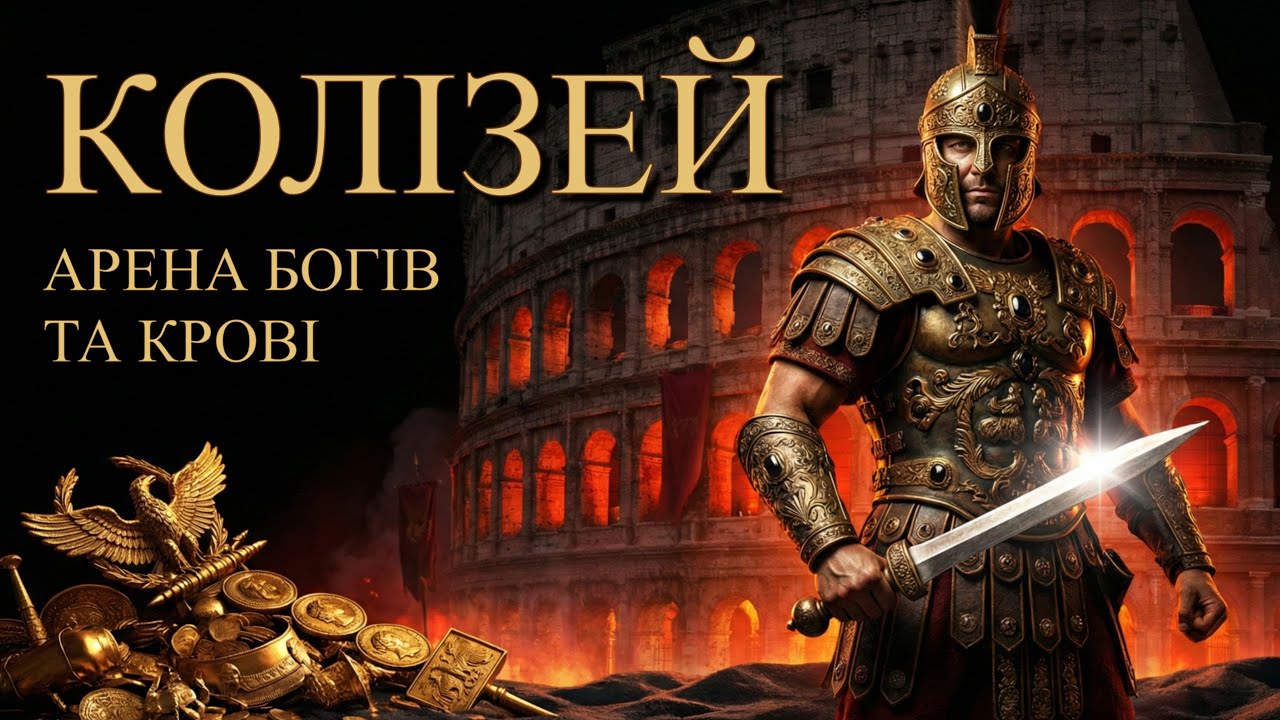
СТРАШНА ПРАВДА ПРО КОЛІЗЕЙ! Машина Смерті, що Шокувала Світ 🩸🏟️
There is a silhouette that every person on the planet knows. An icon that has become synonymous with the Eternal City. A symbol so familiar that it no longer seems real. We see it on postcards, in Hollywood blockbusters, on the pages of textbooks. It is the Colosseum. It is an absolute monument to the grandeur and power of the Roman Empire. Every year, millions of tourists walk through its ruined arches, touch its ancient stones and try to imagine the roar of the crowd and the desperate cries of the gladiators. But that is a mistake. We know it as a tourist attraction, but 2,000 years ago it was the most sophisticated mechanism for entertainment and killing that humanity had ever created. It was not just an arena, it was a machine, a flawless deadly clock built on blood and ingenious engineering. A place where bread and spectacle turned into an industry of death, operating with ruthless efficiency. We think we know the history of the Colosseum, but the truth hidden beneath its blood-soaked arena is far more complex, technological, and terrifying than any myth. This is not just a story about gladiators. This is the story of the political genius of the Flavian dynasty, who realized that to rule Rome, you need to not only feed it, but also put on a show that will make your heart stop in horror and delight. Welcome to the Colosseum, the arena of gods and blood. To understand why the Colosseum was born in the first place, we must descend into the hell that preceded its appearance. In the year 64 AD, into the fire that devoured the Eternal City. When the great fire of Rome subsided, leaving behind a desert of ash and charred ruins, Emperor Nero did something no one expected. He took his time rebuilding Rome for the Romans. He took a huge part of the burned city center for himself. On this ashes he built his own private paradise. The palace was so luxurious, vast and audacious that it went down in history as Nero’s golden house, the house of the aureus. It was not just a dwelling, it was a challenge to the gods and a public slap in the face to the entire Roman people. This complex covered an area of 80 hectares. It had its own parks, vineyards, forests, artificial waterfalls and a giant artificial lake. Right there, in the valley where the residential quarters once stood, Nero ordered a personal pond to be dug for his amusements. Nero’s madness could not last forever. His tyranny led to a rebellion, his declaration as an enemy of the people and, ultimately, to his ignominious suicide. Rome was plunged into the chaos of the bloody year of the four emperors. When a new strong leader finally emerged from this fog of civil war , the pragmatic and experienced general-emperor Vespasian, he was faced with an impossible task. He needed to not just rule, he needed to heal Rome. He needed to erase the very memory of the Tyrant. And he found a brilliant, symbolic solution. What to do with the hated golden house? What to do with the private lake that had become a symbol of tyranny? The Colosseum stands on the site of Nero’s private lake. Vespasian ordered it to be drained to the last drop and on this very spot, at the bottom of the artificial lake, to build not a palace for one, but a gigantic amphitheater for all. It was a brilliant political move to return to the people what the tyrant had stolen. Construction of the Colosseum began. The Flavian dynasty, to which Vespasian belonged, was giving Rome its greatest monument, erected directly on the ruins of the most shameful page of its history. When Vespasian gave the order, Rome faced an impossible task. But the greatest engineering marvel in the history of the Colosseum is not only its size, it is its speed. How did they do it? How did they manage to build this colossus, this super stadium for 80,000 spectators, in just 8 years, using technologies that we can hardly repeat today. The answer is a combination of cruelty, logistics and genius. First, the labor force. It is said that more than 100,000 slaves captured during the suppression of the Jewish revolt were brought to Rome. They became a free endless army of builders, manually dragging giant blocks of travertine weighing 40 tons. But slave labor is nothing without technology. And the main secret of the construction of the Colosseum lies in the material. This is the legendary Roman concrete. The substance is so perfect that it still holds up after 2,000 years. By mixing lime with volcanic ash, Pozzolan, Roman engineers created a material that was lighter than stone, but thanks to the chemical The reaction only got stronger over time and could even harden underwater. But the real genius was the logistics. This engineering marvel of modular construction. The Colosseum is essentially 80 giant vertical sections, placed in a circle. Each arch was an entrance. This allowed thousands of workers to build their sections at the same time, without interfering with each other. It was an ancient assembly line, brought to absolute perfection. They used thousands of standardized parts and cranes powered by human power. Thousands of slaves. Perfect material and impeccable logistics. This was not just a construction site. This was a military operation, guided by the iron will of the Flavian dynasty. In 80 AD, less than 10 years after construction began, the engineering marvel was ready. Emperor Titus, Vespasian’s son and heir , was to officially present this monument to Rome. And to show that the Flavian era was superior to anything that had come before it, he announced the opening of the Colosseum. This was no ordinary festival. This was not a single day of games. This was the greatest and bloodiest opening in human history. Titus announced the games for days. 100 days, more than three months. 100 days of continuous, methodical, industrial murder, designed to show every inhabitant of the empire that Rome’s power was absolute and its resources inexhaustible. Historians such as Cassius Dio described what was happening with horror and delight. The arena, newly built, was immediately drenched in blood. Over 9,000 exotic animals were killed in those 100 days. Lions from Numidia, tigers from Parthia, elephants, rhinoceroses, bears, crocodiles. They were brought from the farthest corners of the empire to die for the amusement of the crowd. But the beasts were only a warm-up. Thousands of gladiators, prisoners of war, convicted criminals, and professional fighters whose lives were worthless fought and died on these sands. The Emperor Titus presented Rome with a spectacle that eclipsed even the madness of Nero. He gave the people bread and spectacles soaked in blood. It was a triumph of engineering and the apotheosis of cruelty. The arena was consecrated. The most sophisticated mechanism for killing was put to full power. The day at the Colosseum began early with the morning program. It had the official name of the Venationes, or hunt, but don’t let that name fool you. It was not a hunt in our sense. It was a bloody theatrical performance that demonstrated the unlimited power of Rome over the entire known world. Roman engineers performed miracles. They did not simply release beasts. Overnight, using the hidden mechanisms of the hypogeum, they transformed the arena into a real living scenery: African deserts, Thracian forests or Egyptian swamps with living trees, rocks and ponds. And onto this stage at dawn they released exotic beasts from the Colosseum. Hundreds, and sometimes thousands of animals from the most remote corners of the empire. This was the same hook. The Romans arranged safaris in the city center. Lightly armed bestiary hunters acted out mythological hunts, killing ostriches, giraffes, leopards and panthers. These were animal fights brought to the point of absurdity. But how did thousands of lions from Africa, rhinoceroses from India and crocodiles from the Nile get to Rome at all? It was a gigantic, cruel logistical machine. Entire legions were involved not in war, but in catching wild animals. They were transported for weeks, if not months, in cramped, dark cages across the turbulent sea. Huge numbers died on the way, but that didn’t matter. The empire was rich, and spectacles were demanded every day. The scale was so insane that the Romans, without even realizing it, destroyed entire species of animals for the sake of entertainment. Within a few centuries of the games, the North African elephant was completely exterminated. The Atlas lion, which once lived in the mountains of Morocco, disappeared from the face of the earth. They devastated entire ecosystems to fill their arena. It was a demonstration of Rome’s absolute power not only over people, but also over nature itself. If the morning show of the Venezionese was a demonstration of Rome’s power over nature, and the evening show of the gladiators was a demonstration of strength and courage, then the afternoon program. The afternoon program belonged to horror. Usually at this time, most respectable citizens left their seats to eat lunch. Only those who could not afford to leave remained in the amphitheater . And it was for them that the ludi arranged the meridians, the midday games. It was the most disgusting part of the day. These were public executions in the Colosseum. But the Romans wouldn’t be Romans if they didn’t turn even that into a spectacle. These weren’t simple quick executions. They turned murder into a sophisticated mythological mockery. They didn’t just kill, they forced the condemned to play roles from myths that always ended in a real brutal death. Imagine a person condemned to death being brought into an arena decorated with scenery. They were given a wooden sword and dressed in a costume, and then a professional gladiator, armed to the teeth, was unleashed on them. This was n’t a battle, it was a massacre. Or worse, the condemned person was forced to play the role of Icarus. He was given wings, lifted on a special mechanism to the very roof of the Colosseum, and then simply dropped down into the arena, where he crashed to his death, and the crowd applauded the successful performance. Another might be dressed as Orpheus, the mythical singer who tamed beasts. He was given a lyre, and then hungry bears were unleashed upon him, which, of course, were not tamed and tore the actor to pieces. It was a terrible theater of the absurd, where death was the only finale. And yes, this was the fate of not only criminals or prisoners of war. It was the fate of many of the early Christians. To Rome, they were not martyrs, they were atheists who refused to worship the emperor. and enemies of the state. They were the first martyrs of the Colosseum. Their unwavering faith in the face of such terrible theatrical death only tempered their community, transforming the arena of blood into an altar. It was not just a sport, it was an instrument of state terror disguised as art. When the arena was cleared of the terrible remains of the midday plagues, and the sun began to sink west, the crowd froze. The main event of the day was beginning . Munera. The main event – gladiators. Who are gladiators? Our imagination, educated by Hollywood, paints us pictures of noble slaves fighting for freedom. But the truth, as always, is much more complicated and interesting. They were really at the lowest rung of society. infamy. These were disgraced slaves, prisoners of war, convicted criminals. Their lives were worth nothing. They were the walking dead. But at the same time they were slaves, but their faces adorned the walls of houses. They were the rock stars of ancient Rome, who risked their lives every day. This is the greatest paradox of the Colosseum. Spectators despised the gladiators for their low status, but at the same time they adored them for their courage. Children played with clay figurines of gladiators, poets dedicated poems to them. Noble women paid crazy money for a night with the champion. They were both destitute and idols. There are many myths about gladiators. The main myth is that they were all slaves who were forced into the arena. This is not true. Over time, many autocracy of free citizens appeared among them. They were former soldiers looking for adrenaline, bankrupt aristocrats trying to earn money, or simply adventurers seeking fame. They voluntarily signed a contract, putting their body and life in the hands of the lanista owner of the gladiator school. This gladiator school or Ludus was not just a training camp. It was a mixture of an elite sports boarding school and a maximum-security prison. Their lives were subject to iron discipline. They received the best medical care that was available in Rome. After all, they were incredibly expensive assets. Their diet is another myth debunked. We imagine them as muscular predators. But analysis of the gladiator bones has shown that their diet was largely vegetarian. They were called ordearii, barley eaters. They ate a huge amount of barley, beans and other carbohydrate foods. This created a dense layer of fat on top of the muscles, and this was done intentionally. This fat protected the nerves and blood vessels from superficial cuts, making the fight longer. and most importantly bloodier, but not fatal. The Natov got his show, and the expensive gladiator stayed alive. Each gladiator was a narrow-profile fighter. There were ritiaris with a net and a trident, secutors in heavy armor, Thracians with small shields, murmiloni with a fish on their helmets. Their fights were not a chaotic brawl, but a carefully thought-out performance, where different styles opposed each other, as in modern wrestling. So who were the gladiators? They weren’t just slaves, they were professional athletes, actors in a bloody theater that teetered on the edge between between shame and glory, between death and adoration. When a gladiator was defeated and fell to the sand, he would raise one finger of his left hand. The adtum gesture. A plea for mercy. His fate was no longer his. He looked at the emperor, and 80,000 spectators began to scream and make gestures. But which ones? This is where the biggest myth begins. Everything you saw in the movie Gladiator about the thumbs down is not true. That famous image of the emperor showing his finger down. Tamsdown is most likely a 10th century invention. popularized by the French artist Jean Leon Gérôme in his famous painting Polis Verso. So how was a gladiator’s fate actually decided? Historical sources, such as Juvenal, only mention this term polis verso, which is Latin for turned finger. But turned where? Historians have argued about this for decades. Many believe that the gesture of mercy is missio. To let go. It was a clenched fist, where the thumb was hidden. This symbolized the sword remaining in its sheath. And what then did death mean? The real gesture was much more terrible and logical. Most likely, it was a thumb pointing up Thumbs Up, symbolizing a naked sword preparing to strike. or according to another even more terrifying version, the emperor made a sharp gesture with his thumb horizontally sideways to his own neck, imitating a sword strike in the throat. It was not just a gesture, it was a cold clinical order to execute. And no Hollywood movie conveys the horror that the defeated felt, seeing this simple but deadly movement of the emperor’s hand. The crowd in the stands saw only what was happening on the mountain in the brightly lit arena: sand, sun and blood. But the real magic, the real wonder , and the real horror of the Colosseum were hidden from their eyes. Beneath the blood-soaked arena was another hidden world. A complex mechanism that worked in the darkness to create magic on the mountain. This was the underground of the Colosseum, known as the hypogeum. The hypogeum. It was a veritable two-story labyrinth of narrow, damp corridors, tunnels, and chambers that took up the entire area under the arena. This was not just a backstage area, it was the engine of this death machine. Here, in the darkness, by the light of torches, hundreds of slaves and workers prepared the next act of the bloody spectacle. Here were cages with dozens, sometimes hundreds, of frightened and enraged wild beasts, freshly brought in from the port. Their roars, coming from underground, must have driven the gladiators themselves crazy. There were tunnels here that led to the Ludus Magnus, the gladiator school located nearby. Through these underground passages, gladiators would walk to their last fight, hearing the roar of the 80,000-strong crowd overhead before they even saw the sunlight. And, of course, there were rooms for props, armories, lasers for the wounded, and, it is said, even chambers for the dead, which were taken out of the arena through special death gates. The Hypogeum was a gloomy, efficient, underground world that never stopped. This is one of the main secrets of the Colosseum. Its show never had a break, because while one performance was going on on the mountain, the next was already being prepared below. But the Hypogeum was not just a backstage area. It was one of the most complex mechanisms of the Colosseum that mankind had ever created. Its main purpose was to create a wow effect. The magical appearance of gladiators and beasts from nowhere right in the center of the arena. Imagine, the viewer sees only flat, even sand. And suddenly, from dozens of different points at the same time, as if from under the ground, exotic trees appear, then gladiators, and then angry lions. How did the Colosseum work? The entire floor of the arena, which was actually wooden, not stone, was pierced by a system of hidden hatches, and under them, in the darkness of the hypogeum, were hidden real engineering wonders: the elevators of the Colosseum. It was a complex system of 28, and according to some sources, even more, hidden elevators and lifting platforms. These were not just ropes, they were complex mechanisms that worked on a system of counterweights, blocks and winches, which were controlled by hundreds of slaves in the dungeon. At the signal, a team of slaves began to rotate huge winches. The platform on which stood a cage with a tiger or a squad of gladiators began to rise. At the same time, another mechanism opened the hatch in the arena, and at the right moment the beast shot into the arena. illuminated by sunlight, shocking and the spectators, and the gladiator himself, who was fighting next to him. And here we come to the real horror of this technology. Imagine, you are fighting in the arena. You are focused on your opponent, you hear the roar of the crowd, and suddenly a lion jumps out of the ground behind you . You didn’t even know there was a hatch. This was not just a battle, it was a trap. It was an engineering marvel that worked on fear. The audience went crazy from such unexpected turns. It was the perfect machine for a show, where the arena itself was your enemy. But if secret elevators and hidden traps amaze the imagination, then the next engineering marvel of the Colosseum simply does not fit in your head. This is perhaps its greatest viral secret. Naumakhia. Real naval battles in the Colosseum. Yes, you are not mistaken, they flooded the Colosseum. This is not a myth. Although it is hard to believe, ancient historians, like Dioncassius, clearly described these water battles. Imagine, suddenly, streams of water were directed into the arena where the gladiators had just fought, filling it several meters high. But how did they do it? Here lies the main mystery. The same hypogeum. The dungeon that we just talked about actually prevented this. With all its elevators and wooden structures, it was not waterproof. So how? The answer is simple and ingenious. At the same time, naval battles in the Colosseum took place before the complex hypogeum that we see today was built. When Emperor Titus opened the Colosseum in 80 AD, the arena most likely had a simple flat floor. or even a continuous pool without basements. Roman engineers simply connected giant aqueducts to the arena, capable of filling it with millions of liters of water in a matter of hours. It was a real pool in the center of Rome. And then just as quickly they drained the water through a complex sewage system deep under the arena. And on this water they put on incredible shows. Specially built flat ships were launched into the arena. Hundreds of fighters, not gladiators, but anavmachiares, reenacted famous sea battles. For example, the battle of the Greeks against the Persians. It was absolute madness. Water, ships, an imitation of a sea battle in the center of a stone amphitheater. True, the era of Naumachia in the Colosseum was short-lived. The next emperor, Domitian, Titus’ brother, realized that magic with elevators and animals jumping out of the ground was much more spectacular and cheaper than water battles. He ordered the construction of the same complex two-story hypogeum that we see today. This engineering solution forever sealed the possibility of flooding the arena, but it left us with one of the most incredible and crazy legends of ancient Rome. But the engineering wonders of the Colosseum did not end underground. Roman engineers solved another equally difficult problem: the heat. Imagine 80,000 people sitting for hours in a stone cauldron under the scorching Roman sun. It was unbearable. And to do this, they created what we would today call a retractable roof. They called it the Velarium. The Velarium. It was a giant system of awnings consisting of thousands of strips of strong canvas, similar to sails, that stretched over the entire spectator area, leaving only the center of the arena open. This turned the Colosseum into a giant, shaded oasis. But how the hell did they do it. And here lies our hook. The Colosseum had its own retractable roof, operated by a thousand sailors. This is no joke. To service the Velarium , a whole team of a thousand, and according to some reports even more Roman sailors, the Militesklasari, were transferred to Rome from the naval port of Misenum, Misinum . Why sailors? Because only they had experience working with such a gigantic system of ropes, blocks and sails. 240 massive stone brackets can still be seen at the top of the outer wall of the Colosseum. Giant wooden masts were inserted into them. From these masts, like a spider’s web, a complex system of ropes ran to the center of the arena. The sailors, working as a single mechanism, synchronously unfolded or folded these thousands of meters of fabric depending on the position of the sun. It was a spectacle no less impressive than the battles themselves. A thousand sailors working at a height of 50 m above the ground, controlling the sails of a giant stone ship. This was the finishing touch to the Colosseum roof. Proof that the word impossible did not exist for Roman engineering. They tamed not only the earth and water, but the sun itself. But nothing, not even Rome, lasts forever. A huge machine The Colosseum, which had been operating for over 300 years, began to malfunction. Why did the Colosseum cease to be an arena? It did not happen overnight. It was a slow, painful agony that lasted for centuries and had three main reasons. The first and most important was the arrival of Christianity. The very faith that they had once tried to destroy on this sand became the state religion. The new morality that replaced paganism could no longer tolerate this bloody theater. One after another, Christian emperors began to restrict, and later ban, gladiatorial fights. The last game took place when the empire was already dying. According to legend, this happened in 404, when a monk named Telemachus ran into the arena, trying to stop the fight, and was torn apart by the crowd. His death so shocked the emperor that the games were banned forever. The second reason was the fall of the Roman Empire. The empire was bursting at the seams. Barbarian raids, economic collapse, decline. Rome simply had no money left for such incredible luxury. To maintain thousands of gladiators, to deliver thousands of animals from Africa, to pay thousands of sailors for the velarium. Bread and spectacles became too expensive. The arena was empty, because the empire went bankrupt. And finally, the third blow was dealt by nature itself. Powerful earthquakes in the 5th and 6th centuries caused irreparable damage to the structure. Part of the majestic outer walls collapsed, turning the perfect oval into the asymmetrical ruin that we know today. The Colosseum was closed, the crowd no longer roared, the animals no longer jumped out of their traps. The giant fell asleep for thousands of years. Its huge empty arches were inhabited by vagrants, magicians and even ordinary people who set up their workshops and homes there. The great arena turned into a quiet, grassy cemetery of its own greatness. The giant slept, but his thousand-year oblivion was not peaceful. He survived earthquakes, but the greatest enemy of the Colosseum turned out to be not nature, but man. The dark ages of the Colosseum began. First, in the Middle Ages, powerful Roman families, such as the Frangipani, turned it into an impregnable fortress. They walled up the arches, built towers and began to fight each other right from the stands where emperors once sat. The Colosseum saw blood again, but this was no longer entertainment, but feudal warfare. But the most terrible destruction came later, during the Renaissance. When the popes decided to turn Rome into the greatest capital of the world, they needed material. Lots of material: marble, travertine, granite. And where to get it? Why extract new stone in the mountains if the world’s largest free quarry is located in the center of the city? The Colosseum has become a great quarry for Rome. For centuries, Roman aristocrats and, most surprisingly, the popes themselves ruthlessly dismantled the giant for parts. They broke out thousands of tons of travertine to build their new palaces and bridges. If you see thousands of smallpox-like holes in the Colosseum today, these are not traces of time, these are traces of looting. In the Middle Ages, metal hunters broke out of the stone the bronze and iron staples with which the Romans fastened the blocks. This weakened the structure and accelerated its destruction. And now the same hook. You will be shocked, but the majestic St. Peter’s Basilica in the Vatican is partly built from the stones of the Colosseum. Yes, this is a bitter irony. In order to build a new grandiose center of Christianity, which we talked about in our film about the Vatican, the popes did not resort to cannibalism, dismantling the symbol of the martyrdom of the first Christians for building materials. The pagan Colosseum and the Vatican were forever linked. The Colosseum’s decline gave birth to a new sanctuary. Its stones, which had once sucked up blood, became the foundation of the main temple of Christendom. The destruction stopped only in 1749. Pope Benedict XIV, perhaps struck by the scale of the looting, declared the Colosseum a holy place, sanctified by the blood of Christian martyrs. He installed the Stations of the Cross and the same great cross that we see in the arena today, the arena of killings became a place of repentance. And here lies the final irony. Although the executions of Christians in Rome certainly took place, as we remember, in Nero’s circus, modern historians have very little evidence that the Colosseum was the main place of their martyrdom. There is no reliable source of that era that would testify to this. It is quite possible that this grand legend was born much later precisely in order to save a giant from complete destruction. But that no longer mattered. The ruin became a symbol. The symbolism of the Colosseum turned out to be stronger than the facts. It became an eternal monument to both the cruelty of the empire and the power of the faith that conquered it. The Colosseum today is an icon that everyone knows. It is the number one tourist magnet. Today it is a symbol of the greatness of Rome. Millions of people take selfies against the backdrop of its arches, admiring the genius of Roman engineers. But do we remember that it was built on blood? Do we remember the thousands of lives of gladiators, slaves and animals sacrificed for entertainment? The Colosseum stands as an eternal silent question to humanity. How thin is the line between civilization and barbarism and how cruel are we capable of for the sake of spectacle? The walls can speak, and we know how to listen to them. If you long to peer beyond the veil of time and visible reality and touch the greatest mysteries of humanity, then join our expedition. Subscribe to our channel and we will become your guide to a world where history is much stranger and more interesting than you can imagine. Click on the bell, because the darkest secrets await those who dare to hear them.
КОЛІЗЕЙ: Арена Богів та Крові.
СТРАШНА ПРАВДА ПРО КОЛІЗЕЙ! Машину Смерті, що Шокувала Світ 🩸🏟️.
Колізей — це не просто туристична пам’ятка Риму, а найдосконаліший механізм для вбивств в історії людства. Як інженери Римської імперії збудували цю “машину смерті”? Дізнайтесь шокуючу правду про гладіаторів, морські битви на арені та те, як Колізей став каменоломнею для Ватикану.
У цьому випуску ви побачите зворотний бік величі Риму: від божевілля Нерона до геніальних ліфтів, що піднімали левів прямо на арену. Ми розвінчаємо голлівудські міфи та покажемо справжнє обличчя античних розваг.
⏱️ ТАЙМКОДИ:
[00:00] — Вступ: Туристична листівка чи місце жаху?
[01:50] — Безумство Нерона та Велика пожежа Риму
[03:21] — Веспасіан і народження Колізею
[04:38] — Інженерне диво: Римський бетон, раби та логістика
[06:43] — Криваве відкриття: 100 днів безперервних ігор
[08:31] — Ранок на арені: Полювання на екзотичних звірів
[10:46] — Полудень жаху: Театралізовані міфологічні страти
[13:11] — Гладіатори: Рок-зірки античності чи смертники?
[16:48] — Міф про “Палець вниз”: Як насправді вирішували долю?
[18:53] — Гіпогей: Пекло під сценою та секретні ліфти
[22:52] — Навмахія: Як затоплювали Колізей для морських битв?
[25:35] — Веларій: Гігантський дах, яким керували моряки
[27:37] — Занепад імперії: Чому ігри припинилися?
[30:01] — Як Папи Римські розібрали Колізей для Ватикану
[33:16] — Висновки: Ікона, збудована на крові
#Колізей #ІсторіяРиму #Гладіатори #РимськаІмперія #ЦікавіФакти #Архітектура #Історія #РельєфДевелопмент #Научпоп #МіфиІсторії #Інженерія #СтародавнійСвіт #Рим #Подорожі #ДокументальнеКіно #Colosseum #Roma #SPQR #Gladiator