
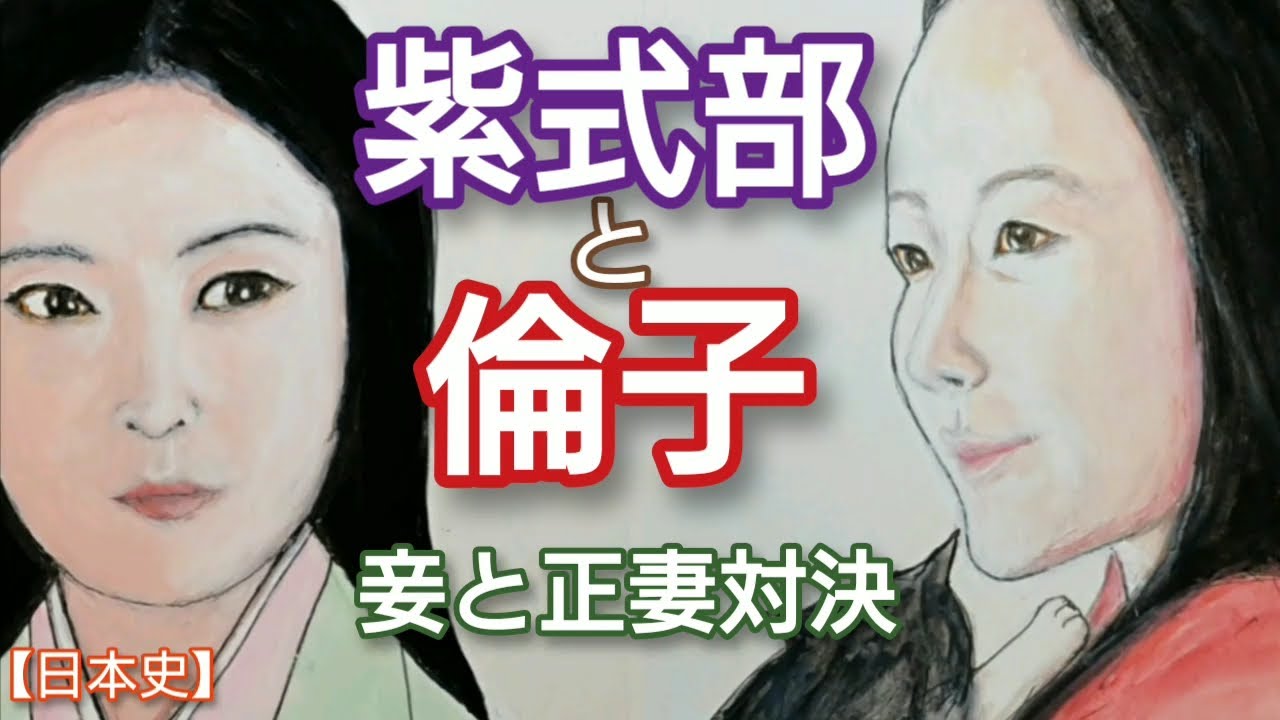
「光る君へ」に学ぶ日本史 紫式部と源倫子 妾と正妻・吉高由里子と黒木華の見ごたえある直接対決 藤原道長を押し上げ創った女たちのその後 Japan
Murasaki Shikibu and Rinko
Learning about Japanese history from “To
Shine”
Confrontation between concubine and lawful
wife
Murasaki Shikibu was a concubine of Fujiwara
no Michinaga, as recorded in the early Japanese
genealogy collection “Sonbi Shonki.”
As a result, Murasaki Shikibu encountered
several face-to-face confrontations with Rinko,
Michinaga’s legal wife.
Let’s take a closer look at what happened
to Murasaki Shikibu and Rinko.
Fujiwara no Michinaga married Rinko, the daughter
of MINAMOTO no Masanobu, the Minister of the
Left, in 987, at the age of 22.
Rinko was 24 years old at this time, and was
Michinaga’s older sister and wife, two years
older than him.
By marrying Rinko and becoming her son-in-law,
Michinaga inherited the vast Tsuchimikado
residence and a huge amount of property, gaining
a foothold in power.
The fifth son, Michinaga, lost his two older
brothers, Michitaka and Michikane, following
his father, Kaneie, and became the successor
of the Kujo-ryu Fujiwara clan.
Michinaga also won a power struggle with his
older brother Michitaka’s eldest son, Ishu,
and had his eldest daughter with Rinko, Shoko,
enter Emperor Ichijo’s court.
On the other hand, Murasaki Shikibu married
Fujiwara Nobutaka and gave birth to her eldest
daughter, Kenko, in the year that Akiko entered
the court.
However, her husband Nobutaka died of an epidemic
just three years after her marriage.
Murasaki Shikibu, who became a single mother
at the age of 29, is said to have started
writing “The Tale of Genji” after Nobutaka’s
death.
Murasaki Shikibu showed only his friends the
Tale of Genji he had written, but word of
his excellent work quickly spread throughout
the imperial court.
By the way, Rinko and Murasaki Shikibu are
said to be cousins, and their mansions are
next door to each other.
Therefore, the prevailing theory is that Rinko,
having heard about the reputation of “The
Tale of Genji,” hired Murasaki Shikibu to
be Akiko’s wife.
When Murasaki Shikibu was 34 years old, she
started working as a wife in charge of education
for 18-year-old Chugu Akiko.
In the drama, Murasaki Shikibu and Michinaga
have known each other since childhood.
In fact, it is quite possible that Murasaki
Shikibu and Michinaga are also cousins.
However, Murasaki Shikibu was hired to attract
the love of Emperor Ichijo, who loved literature,
towards his daughter Shoko.
To this end, Rinko and Michinaga assigned
Akiko to serve as talented wives such as Akazomeemon
and Izumi Shikibu.
At first, Murasaki Shikibu was just one of
those wives.
However, as “The Tale of Genji” became extremely
popular and even Emperor Ichijo became a fan,
Murasaki Shikibu’s position rose dramatically.
Emperor Ichijo began to frequently visit Shoko,
where Murasaki Shikibu was, to read “The
Tale of Genji,” and naturally he often stayed
there.
Two years after Murasaki Shikibu entered the
service, Shoko gave birth to Imperial Prince
Atsunari (later Emperor Goichijo), and three
years later, Imperial Prince Atsunari (later
Emperor Gosuzaku).
For Michinaga, Murasaki Shikibu was truly
a cupid who brought good luck, and a god of
good fortune that he could never let go of.
For this reason, Michinaga seems to have suddenly
changed his approach to Murasaki Shikibu around
this time.
One day, Michinaga suddenly visited Murasaki
Shikibu’s room early in the morning.
Murasaki Shikibu, who had seen his face right
after he woke up, was confused by Michinaga’s
appearance in his splendid appearance.
Michinaga gives Murasaki Shikibu a branch
of a fully blooming Jōro flower that was
blooming in her garden, and suddenly asks
her to compose a waka for him.
This action clearly conveys Michinaga’s desire
to attract Murasaki Shikibu’s attention.
On another occasion, Michinaga noticed that
“The Tale of Genji” was placed in front
of Chugu Akiko.
Then, while chatting with Murasaki Shikibu,
Michinaga wrote the following poem on a piece
of paper that was placed under the plum tree.
“If you call it a favorite thing, I think
it’s just the fault of the beholder.”
The meaning is that plum fruit is sour and
delicious, so no one would pass by it without
breaking a branch.
In other words, Michinaga sent Murasaki Shikibu
a poem that said, “You have a reputation
for being a lover of love affairs, so no man
will pass you by without wooing you.”
Murasaki Shikibu then returned the following
song to Michinaga.
“Someone dares to say that they love something
that has not yet been broken by others.”
It means, “The plum tree has not yet been
broken by anyone, so who ate the sour fruit
and snarled?”
Murasaki Shikibu retorted, "I don’t have any
experience with men yet, so it’s unreasonable
for me to start rumors about who I’m in love
with."
Murasaki Shikibu’s diary states that that
night, someone visited Shikibu while he was
sleeping in the Watari-dono.
The knocking at the door continued until morning,
but Murasaki Shikibu did not open the door,
but it was Michinaga.
In other words, Michinaga continued to persevere
in his efforts to somehow gain control of
Murasaki Shikibu.
Although the two did not write in their diaries
that they became lovers, it is thought that
Murasaki Shikibu became Michinaga’s mistress
around this time.
At the time, it was common for upper-class
aristocrats to have multiple concubines in
addition to their legal wives, so it would
have been unnatural for a widowed woman to
say no when approached by the most powerful
person at the time.
Concubinage was also a system that provided
financial relief and protection for single
mothers and others.
So, what kind of personality was Rinko, the
legal wife, and what did she think of Murasaki
Shikibu?
Regarding Rinko’s personality, “Eika Monogatari”
describes Rinko’s behavior as follows when
Michinaga took Minamoto no Akiko, the grandson
of Emperor Daigo, as his other wife.
“Michinaga lived with Rinko on such a friendly
terms that they never let her get away with
him, but eventually he became close with Minamoto
no Takaaki’s youngest princess, Akiko.”
“Even though Rinko, the princess of Tsuchimikado,
is having a hard time, she has a very calm
temperament, so she is calm and gentle.”
Rinko seems to have been a reserved woman
who did not express her emotions too much.
However, Rinko’s “Murasaki Shikibu Diary”
says that she was different when she saw Murasaki
Shikibu and Michinaga getting close.
When Shoko gave birth to Imperial Prince Atsunari
(later Emperor Goichijo), Michinaga held a
grand celebration ceremony.
At a banquet celebrating the 50th day of his
birth, a drunk Michinaga playfully attacked
Murasaki Shikibu, grabbed her by the sleeve
of her kimono, and demanded that she compose
a song.
Murasaki Shikibu wrote, “Whatever you do,
you are 8,000 years old, but it’s been a long
time since you passed away.”
Murasaki Shikibu wrote a poem.
When Murasaki Shikibu prayed for the long
life of the Imperial Prince on his 50th birthday,
Michinaga hummed Murasaki Shikibu’s song twice,
saying, “You’re really good,” and then composed
the following poem in return.
“If tomorrow’s day is so long, I will take
the number of thousand years of your generation
into the number.”
“I want to live for a thousand years, like
a crane standing by the reeds, and watch over
the prince.”
Michinaga wrote a poem about his feelings
at that time, and then addressed Akiko as
follows.
"What do you think, Chugu-sama?
She must have done a good job of reciting
the poem.
I’m sure her mother Rinko also thinks she
has a good husband."
It seems that Michinaga, who spoke to Chugu
in this way, was the type of person who became
angry when he got drunk.
Murasaki Shikibu listened to her, thinking
it was
her drunken nonsense, but perhaps thinking
Rinko was being too loud, she suddenly became
in a bad mood and left her room.
Furthermore, in the “Murasaki Shikibu Diary”,
she writes about the time when she received
her special gift from Rinko.
It happened on September 9th of
a certain year, the Chrysanthemum Festival,
also known as the Chrysanthemum Festival.
At that time, it was said that if you covered
a chrysanthemum with cotton the night before
and wiped your face and body with the cotton
that had been moistened with morning dew,
you would be rejuvenated.
Therefore, on that day, Rinko delivered her
cotton to Murasaki Shikibu, saying, “Wipe
her face with this cotton to prevent aging.”
Then Murasaki Shikibu said, “I only need
a little bit of the chrysanthemum dew, so
I’ll leave the rest to my wife.”
Murasaki Shikibu tried to return the favor,
saying, “Please make me 1,000 years younger,”
but he remembered this and decided against
it, he wrote in his diary.
If Murasaki Shikibu had really returned Rinko’s
chrysanthemum dew, she would have been in
a lot of trouble.
Rinko is two years older than Michinaga, so
Murasaki Shikibu is nine years younger.
This exchange can be interpreted as a confrontation
between Michinaga and his legal wife in a
competition for youth.
Both women were said to be talented, so I’m
sure they never fought in a way that showed
their emotions.
However, Murasaki Shikibu and Rinko may have
been burning with intense jealousy on the
inside, though it was not shown on the surface.
紫式部は系図集「尊卑文脈」に「道長妾」と書かれているように道長の愛人であった可能性が高いが、正妻の源倫子は紫式部にどのように接していたのだろうか。上流貴族は多くの妾を持つのが普通であった時代に倫子は特別な行動を・・
作曲 秋山裕和
http://www.hmix.net/
#nhk大河ドラマ #光る君へ #日本史 #歴史