
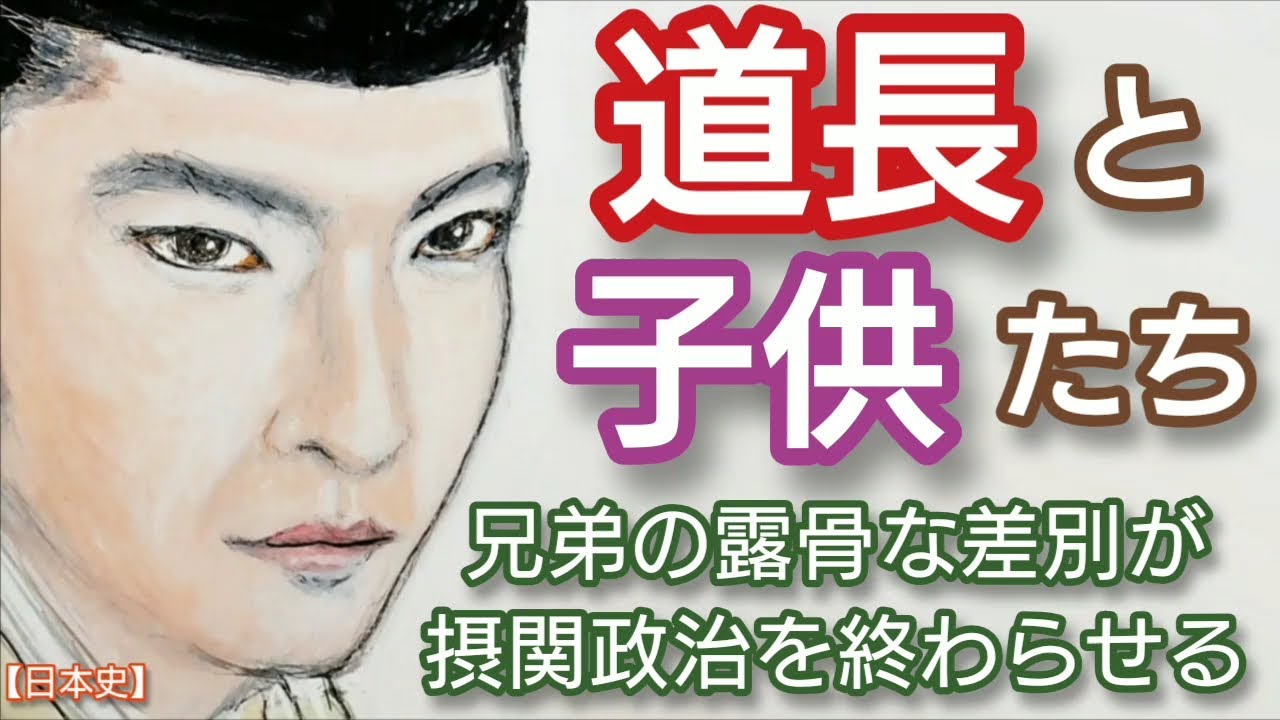
「光る君へ」に学ぶ日本史 黒木華と瀧内公美が競演 藤原道長の二人の妻の子供たちへの差別が摂関政治を終わらせた!?藤原氏の絶頂期から奈落への急展開 Japan
Fujiwara Michinaga and children Learning about Japanese history from “To Shine” Blatant discrimination against brothers brings an end to regent politics Fujiwara no Michinaga had two legal wives: MINAMOTO no Rinko, the daughter of MINAMOTO no Masanobu, and MINAMOTO no Akiko, the daughter of MINAMOTO no Takaaki.
Rinko and Akiko each gave birth to six children and seemed to have solidified the foundations of regent politics. However, the daughter of Yorimichi, who succeeded Michinaga, did not have a prince, and the regent government quickly came to an end. Let’s take a closer look at what happened to Fujiwara Michinaga and his children.
Fujiwara no Michinaga had two official wives, Minamoto no Rinko and Minamoto no Akiko. However, because Michinaga lived with Rinko at the Tsuchimikado residence, it is said that Rinko was his legal wife. Rinko appears overwhelmingly in “Mido Kanpakuki” written by Michinaga.
He and his girlfriend Rinko had six children: two boys, Yorimichi and Norimichi, and four girls, Akiko, Kako, Takeko, and Yoshiko. In addition, he and his girlfriend Akiko had a total of six children: four boys, Yorimune, Akinobu, Yoshinobu, and Nagaie, and two girls, Hiroko and Takako.
Michinaga was blessed with many children, especially girls, which gave him an advantageous position in regent politics. And Michinaga clearly created a disparity between Rinko and Akiko’s children. As I explained in detail in the video “Michinaga’s Wives,” Rinko was the great-granddaughter of Emperor Uda, and Akiko was the grandson of Emperor Daigo.
In terms of blood relations, Akiko was more noble than Rinko, and both of her fathers were Ministers of the Left. However, while Rinko’s father, MINAMOTO no Masanobu, was the current Minister of the Left, Akiko’s father, MINAMOTO no Takaaki, was a former Minister of the Left, and was also a criminal.
At that time, Michinaga lived in Rinko’s Tsuchimikado residence and inherited her huge inheritance from Minamoto no Masanobu. It was because of Masanobu’s legacy that Michinaga was able to defeat his greatest rival, Fujiwara Ishu. Therefore, Michinaga naturally tends to prioritize Rinko’s children over Akiko.
Furthermore, the following episode shows that Rinko did not back down when it came to her children. At the 40th birthday celebration of Michinaga’s older sister and Emperor Ichijo’s birth mother, Higashisanjoin Shoko, Rinko’s 10-year-old son, Yorimichi, and Akiko’s 9-year-old son, Yorimune, performed a dance.
Higashisanjoin adopted Akiko as his daughter for a period before she married Michinaga. For this reason, Higashisanjoin naturally cared for Yorimune, who was her Akiko’s son. At this time as well, Higashisanjo-in awarded Yorimune’s dance master the rank of Junior Fifth Rank (lower rank) as a reward, but nothing was said about Yorimichi’s master.
Rinko then complained that it was unfair to have only one side. Therefore, the rank was later given to Yorimichi’s teacher as well. At the time, Higashisanjoin Akiko had no equal in power as Emperor Ichijo’s biological mother, but Rinko fiercely protested.
By this time, Rinko had already established her position as Michinaga’s legal wife, who could openly protest even to Higashisanjoin Shoko, who was said to be her country mother. As a result, Rinko’s son Yorimichi was promoted to Minister of the Interior at the age of
26, and Norimichi was promoted to Chunagon at the age of 22, making them significantly younger than other court nobles. Furthermore, Rinko’s daughters became in an unprecedented situation where they were said to be “three empresses in a family,” giving Michinaga the position that she was the emperor’s
Maternal grandfather, and that her son Yorimichi was the maternal uncle. Unlike other diaries of the same period, such as Sanesuke Fujiwara’s “Shoyuki,” Michinaga’s “Mido Kanpakuki” features his wife Rinko and daughters Akiko and Kako very frequently. This shows that they were particularly important politically.
There is a clear difference between Rinko’s children and Akiko’s children in terms of promotions for boys and marriage destinations for girls. Regarding the boys, Rinko’s son Yorimichi was 5 years old and Norimichi was 15 years old when they joined the ranks of court nobles.
On the other hand, Akiko’s sons were promoted to court nobles when Yorimune was 19 years old, Yoshinobu was 20 years old, and Nagaie was 18 years old. Furthermore, Kenshin was forced to become a priest before becoming a court noble. Only Rinko’s sons Yorimichi and Norimichi became regents and Kanpaku.
Regarding the women’s marriages, Rinshi’s daughter Shoko married Emperor Ichijo, Kako married Emperor Sanjo, Takeshi married Emperor Goichijo, and Ushiko married Imperial Prince Atsunaga (later Emperor Go-Suzaku), but she died before ascending the throne. . In any case, all four of Rinko’s daughters became Chugu.
However, Akiko’s daughter Hiroko married Imperial Prince Atsuakira, and Takashi was married to Minamoto no Morofusa, and neither of them became Chugu. Imperial Prince Atsuakira was the first son of Emperor Sanjo, but he voluntarily declined the position of Crown Prince under pressure from Michinaga.
After the death of Emperor Sanjo, Michinaga adopted the Imperial Prince as the son-in-law of his daughter Hiroko, partly as a way of repaying Imperial Prince Atsuakira, who had stepped down as Crown Prince. However, his wife, Nobuko, who had already given birth to a prince, and her father, Fujiwara
No Akimitsu, died one after another amid intense grief. Therefore, in “Eika Monogatari,” it is written that when Hiroko fell ill at the young age of 27, two vengeful spirits appeared to her on her deathbed. As mentioned above, Michinaga openly discriminated against Rinko and Akiko’s children, and Akiko’s children were not at ease.
In particular, Yoshinobu, who had a strong personality similar to his father Michinaga, became violent in 1009 during a ceremony to celebrate the birth of his half-sister Akiko, Imperial Prince Atsushi (later Emperor Go-Suzaku). . Yoshinobu insulted Inari Fujiwara, Major General of the Sakon Guards, who was present, and
Yoshinobu’s followers, who joined him, assaulted him unilaterally. Inari was furious, but he could not do anything since his partner was Michinaga’s son, so he finally became a monk. Furthermore, Yoshinobu was involved in an incident of abusing a servant of Rinko’s son, Norimichi Fujiwara, the Minister of the Interior.
In 1022, the second year of the peace era, 28-year-old Yoshinobu and 27-year-old Norimichi caused a stir with their flamboyant sibling quarrel. Fujiwara Sanesuke’s “Shoyuki” tells us that on the morning of March 23 of that year, the servants of FUJIWARA no Norimichi, Minister of the Interior, suddenly destroyed the house
Where the servant of FUJIWARA no Yoshinobu, the Dainagon of the Prime Minister, lived. However, this was retaliation against Yoshinobu from Rinko’s son, Norimichi. In fact, two days before this, an incident had occurred in which Gon Dainagon Yoshinobu abducted and imprisoned a servant of the Minister of the Interior, Norimichi.
The person Yoshinobu imprisoned in his residence was Norimichi’s chief of staff. As the name suggests, the “Routenincho” is the head of the “Routenincho” who is responsible for taking care of the horses. Therefore, even though they were called servants, the nincho was a servant with a somewhat higher status.
The head chef was abducted, imprisoned, and assaulted, but his whereabouts after that are unknown. Sanesuke wrote in “Shoyuki” that the cause of the conflict between Yoshinobu and Norimichi was land issues and land disputes. Fujiwara no Michinaga considered the successors to his government to be Yorimichi and Norimichi,
Who were born to Rinko, and not Yorimune and Yoshinobu, who were born to Akiko. Yorimichi was given the position of regent by Michinaga and later became Kanpaku. Norimichi, Yorimichi’s younger brother and Rinko’s son, succeeded Yorimichi as Kanpaku. Akiko’s sons Yorimune and Yoshinobu were never given the chance to become regents or Kanpaku.
At the time of the dispute between Yoshinobu and Noromichi over a land issue, Yoshinobu was 28 years old and was Gon Dainagon, while Noromichi was 27 years old and had already become Minister of the Interior. FUJIWARA no Yorimichi became Jusanmi (Junior Third Rank) at the age of 15, and after that
He rapidly rose through the ranks, becoming Minister of the Interior in 1017, the first year of Kannin. It is thought that Michinaga wanted his son to succeed as regent while he was still alive, as there was a fierce battle between his brothers, cousins, uncles and nephews to become regent and Kanpaku.
In other words, in order to prevent the brothers from fighting over his position, he created a disparity between the children of Rinko and Akiko. Therefore, Yorimichi remained under Michinaga’s protection for ten years until his father Michinaga passed away. Yorimichi served as regent and Kanpaku for his nephews Goichijo, Gosuzaku, and Goreizei
For more than 50 years. However, this was because Yorimichi was not blessed with a successor. As a result, Yorimichi eventually handed over the post of Kanpaku to his 72-year-old younger brother by the same mother, Norimichi, in 1068. The elderly Noritoshi also passed away seven years later.
Furthermore, because the daughters and adopted daughters that Yorimichi brought into the court did not give birth to princes, the relationship with maternal relatives could not continue, and the regent government ended. Emperor Gosanjo, who had no connection to the Fujiwara Kujo school, ascended the throne, bringing an end to the 300-year-old regent government.
Based on his own experience, Fujiwara Michinaga created a disparity between the children of Rinko and Akiko in order to avoid sibling rivalry. Akiko’s children left behind many more talented children than Rinko’s. Despite this, the descendants of Akiko’s children were not given a chance to play an active role.
Fujiwara no Michinaga took measures that he thought were good, but ended up ending the regent government early.
藤原道長には源倫子と源明子という二人の正式な妻がいたが、二人の子供たちを道長は露骨に差別した。そのため明子の息子・能信は倫子の息子・教通の従者を襲う事件を起こしているが・・
作曲 秋山裕和
http://www.hmix.net/
#nhk大河ドラマ #光る君へ #日本史 #黒木華