
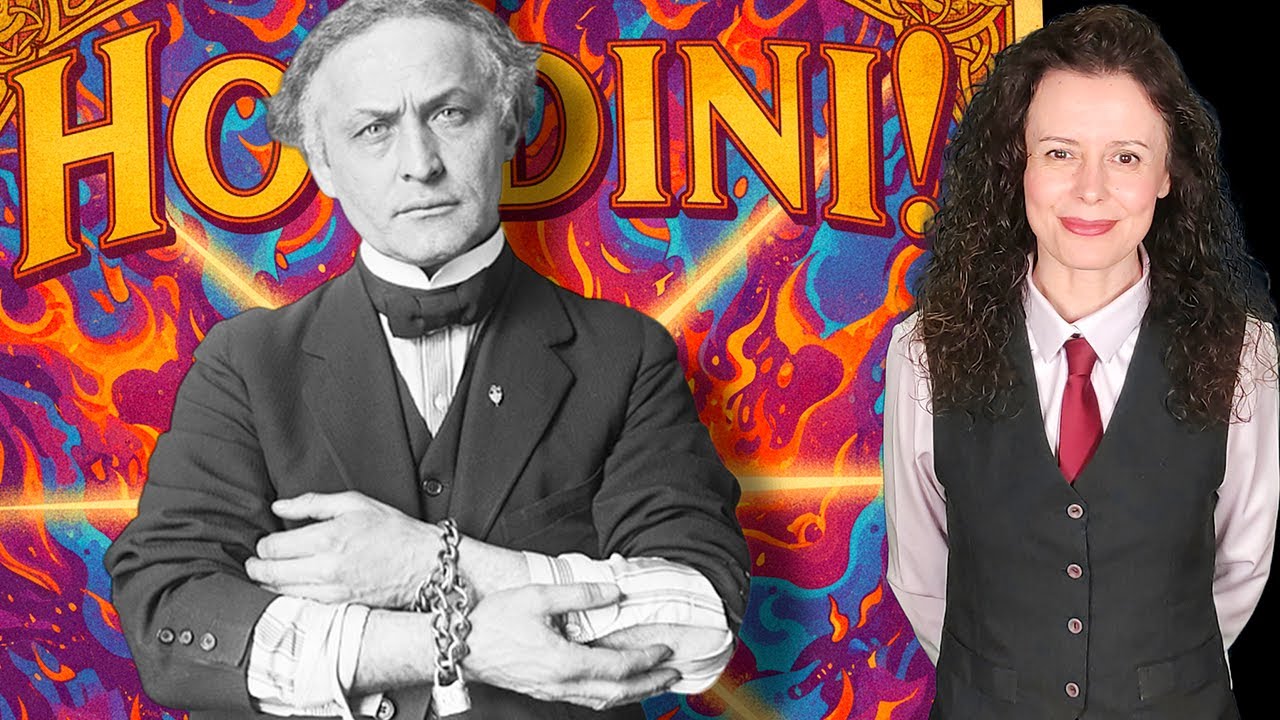
¿Houdini fue un espía y murió envenenado? | Biografía de Harry Houdini
Welcome, curious minds! Do you know the story of the master escape artist Harry Houdini? Did you know that some experts believe he led a secret life as a spy? And that his fight against superstition and paranormal fraud led him to join forces with the writer H.P. Lovecraft and confront a Spanish aristocrat with alleged superpowers? “Doing a Houdini” is synonymous with disappearing, achieving the impossible, escaping when all escape routes seem sealed. But who was really the man hiding behind the chains and padlocks? A con artist, a marketing genius ahead of his time, an obsessive crusader against spiritualist fraud? Or all of the above? Once again, to unravel this mystery, we will try to separate the man from the myth. Harry Houdini was born Erik Weisz in Budapest, the present-day capital of Hungary, then part of the Austro-Hungarian Empire. He came into this world on March 24, 1874 , the fourth of seven children. When he was just four years old, his Jewish family crossed the Atlantic aboard the steamer SS Frisia in pursuit of the American dream. They settled in Appleton, Wisconsin, where his father, Rabbi Mayer Samuel Weisz, hoped to lead a new congregation, made up primarily of German immigrants. The family, incidentally, changed their surname to the more American-friendly spelling Weiss. For a time, the family lived comfortably, and the rabbi was a respected figure in the community. However, in 1882, when Erik was eight years old, his father was fired. The reasons for this were varied: on the one hand, Rabbi Weiss was considered too “old world” for a congregation seeking to modernize; and, on the other hand, his inability to speak English fluently proved a significant obstacle in an increasingly Americanized community. Some sources also explain that as the number of German immigrants in that congregation increased, they preferred to elect a leader from their own community. After this dismissal, the family fell into extreme poverty. To help out at home, Erik, barely eight years old, had to work on the streets selling newspapers and shining shoes. His childhood was marked by a constant struggle for survival. This was his first great act of escapism: a tenacious escape from poverty through an ambition and work ethic that would define him forever. The world of show business offered him a glamorous outlet. At nine years old, young Erik already displayed astonishing physical agility. He convinced his mother to make him a pair of red tights and, together with his friends, formed a small neighborhood circus. His debut, on October 28, 1883, was as a contortionist and trapeze artist under the stage name Ehrich, the Prince of the Air. He also worked as a locksmith’s apprentice, which helped him acquire knowledge that, as we shall see, served him well as he became the “king of handcuffs.” In 1887, at the age of 13, he moved with his father to New York in search of better opportunities, and was later joined by the rest of the family. The moment that truly changed the young man’s destiny came when he read a book in 1890, when he was around 16. It was the memoirs of the famous French magician Jean-Eugène Robert-Houdin. Erik was fascinated by Robert-Houdin, in whom he found not only an idol but a role model, a man who had elevated fairground magic to the most prestigious theaters. In an act of bold appropriation, Erik Weiss decided to adopt his hero’s surname, but added an “i” at the end. Why did he do that? The story goes that a friend of his named Jacob Hyman told him about a custom in France: if you added the letter “i” to the end of your mentor’s last name, it was a way of showing admiration. In reality, this supposed French custom didn’t exist as such, but it helped create one of the most famous stage names in history. Furthermore, that final “i” made the name easier to pronounce for English-speaking audiences. That’s how Harry Houdini was born. It wasn’t a simple name change; it was the first act. of constructing an identity, the first stone in the edifice of his own mythology. His beginnings as a magician were humble: although he initially focused on card tricks and traditional magic, he soon began to incorporate small escape acts. He performed in so- called “dime museums” and freak shows, sharing the bill with bearded women and strongmen for a paltry salary. He worked with one of his younger brothers, Theodore ‘Dash’ Hardeen, and they called themselves “The Brothers Houdini.” In 1894, at the age of twenty, his personal and professional lives took a turn. He met Wilhelmina Beatrice ‘Bess’ Rahner, a young singer and dancer from Coney Island. She was 18. They fell in love and were married within weeks. Bess replaced Houdini’s brother, ‘Dash’, onstage. She remained his companion, assistant, and confidante for the rest of his life. Together they perfected the act that would catapult them to fame: “The Metamorphosis.” The effect was as swift as it was astonishing: Houdini was tied up, placed in a knotted sack, and finally locked in a heavy wooden trunk secured with padlocks. Bess would climb onto the trunk lid and lift a curtain so that it completely covered her for a moment. Three claps later, Houdini himself would appear in her place. And when they opened the trunk, they would find Bess inside, tied up and in the sack, just as her husband had been just three seconds before. You may be wondering how they did it. And we hope that the magicians watching this documentary won’t be too hard on us for unraveling the mystery. The main secret lay in the trunk’s construction. Although it appeared solid and could be superficially inspected, it contained a hidden panel or a section of the hinged lid. Often, a wooden slat on the lid concealed a hinge, allowing a portion to open from the inside. Houdini was tied, often with his hands behind his back, and placed inside a sack. However, the wrist restraints had just enough slack for him to quickly free himself. Once inside the sack and trunk, and as soon as the lid was closed, within seconds, Houdini would be free of his restraints and step out of the sack, which was tied at one side but completely open at the bottom. This is where speed and coordination with Bess were crucial. Bess would climb onto the trunk lid and lift a curtain that completely covered her and the trunk. In that instant of concealment, Houdini, now free inside the trunk, would open the secret panel from the inside and step out, hiding behind the curtain or the trunk itself. Simultaneously, Bess slipped into the trunk through the same panel. The feat is even greater when we consider that this entire exchange occurred in less than three seconds. Once inside the trunk, Bess quickly climbed into the sack and put on the wrist restraints, which Houdini had prepared. This trick was not only a feat of speed and precision, but the perfect metaphor for the life of its creator. For Houdini’s life consisted of a constant metamorphosis: the transformation from Erik Weiss into Harry Houdini, from a poor immigrant into a global superstar, from a card magician into the king of escape artists, and finally, from a performer into a crusader against fraud. As Joe Posnanski, author of The Life and Afterlife of Harry Houdini, suggests, this man’s phenomenon was based on “the power of imagination and self-invention.” The metamorphosis act was not only his first major success; was the promise that any bond, any trunk, any limitation could be overcome. Houdini, besides being a master of escapism, was also a pioneer of marketing and self-promotion. He understood the emerging power of the media long before his contemporaries. His strategy was as simple as it was brilliant. Instead of paying to place advertisements in the press of the time, he did something that was cheaper and more efficient in attracting the public’s attention: he became the news himself. Upon arriving in a new city, he didn’t paper the streets with posters; instead, he threw up A free, public challenge. He would show up at the local police station and dare the officers to lock him in their most secure cell or restrain him with his own handcuffs. The press, hungry for sensational stories, flocked to the scene. Houdini, often stripped to prove he wasn’t hiding lockpicks, was locked up before the eyes of reporters and photographers. His inevitable escape made the front page of every newspaper. As biographer Eduardo Caamaño notes, Houdini was “a great propagandist and a master of publicity” who knew how to harness the power of the media like no other. With the entire city talking about his feat, theaters were packed night after night. This strategy created a powerful feedback loop. Public challenges weren’t just a marketing tool; they were his real-world training ground. Each new lock, each different cell, provided him with a wealth of experience, honing his skills under immense pressure. His growing skill allowed him, in turn, to carry out even more audacious and spectacular promotional acts. Marketing fueled his skill, and his skill fueled his marketing, in a cycle that propelled him to the top. Seeking to erase his immigrant origins and fit the archetype of the self-made American hero, he claimed from 1900 onward that he was born in Appleton, Wisconsin, a lie he maintained until his death in 1926. That year, his growing fame took him to Europe. But before that, let’s explore a lesser-known side of him: his career as a secret agent. The theory that the illusionist led a double life as an international spy emerged in 2006 with the publication of a book written by William Kalush and Larry Sloman, entitled “The Secret Life of Houdini.” According to this book, the illusionist was recruited by the head of the United States Secret Service, John E. Wilkie, in 1898. He also carried out his first mission a year later, coinciding with a tour of the West Coast of the United States and an investigation the Secret Service was conducting in that same area into a case of silver dollar counterfeiting, a subject on which Houdini had received training, according to the research conducted by Kalush and Sloman. As mentioned before, in 1900 Houdini went on tour to Europe, where he proclaimed himself “The King of Handcuffs” for his skill in undoing any type of lock. That same year, he demonstrated his skills in undoing handcuffs at the Metropolitan Police headquarters in London, and Superintendent William Melville, a key figure in the founding of modern British intelligence at Scotland Yard, reportedly witnessed the event . Melville decided to recruit him as a secret agent. According to this espionage theory, Houdini’s acclaimed tours of Europe, especially his stays in Germany and Russia in the years leading up to World War I, were not merely artistic, but served as perfect cover for intelligence-gathering missions. What do Kalush and Sloman base their defense of the Houdini spy theory on? The key piece is William Melville’s diary, which contains entries mentioning an “HH” and the receipt of “reports” from this source while in Germany. Furthermore, the book highlights Houdini’s close relationship with the International Association of Chiefs of Police, an organization that had given him access to high-level law enforcement figures, including John E. Wilkie himself. But is this theory really credible? Let’s analyze it. It is true that Houdini possessed a skill set extraordinarily suited to espionage: he was a world-renowned expert on locks, safes, and all manner of security mechanisms. His mastery of deception, distraction, and the art of escape, combined with ironclad physical and mental discipline, made him a natural candidate for covert operations. Furthermore, his international fame gave him access to the highest circles of society. European, including the nobility and royal courts, such as that of Tsar Nicholas II. More importantly, his method of self-promotion, which consisted of challenging local police forces to lock him in their cells and handcuff him, gave him intimate and legitimate access to police stations, prisons, and security installations across the continent. This was perfect cover for observing police methods, personnel, and technology. The geopolitical context of his European tours also strengthens the possibility of this theory being true. His performances in Germany and Russia between 1900 and 1913 took place during a period of rising international tensions that would culminate in the First World War. A keen observer like him in these nations was invaluable to British and American intelligence services. Of course, he was polyglot. He was fluent in Hungarian, his mother tongue, Yiddish, due to his Jewish roots, English, and also German, given that he spent long periods in Germany and built a foundation for his European career. Furthermore, due to his constant international tours, it’s very likely that he had a working knowledge of other languages, such as French, although not as fluently as the other languages we’ve mentioned. Likewise, there is a documented precedent for Houdini’s willingness to collaborate with the United States government on security matters. During World War I, Harry Houdini, in addition to acting as a propagandist and fundraiser—selling millions of dollars in Liberty Bonds—shared his knowledge with the troops. He gave soldiers free lessons in practical escape techniques, such as freeing themselves from ropes and, very specifically, freeing themselves from German handcuffs if captured. He also offered valuable survival tips based on his famous water escapes, such as how to stay calm and conserve air underwater. So… yes, it’s plausible to think that Houdini, with the necessary skills, access, and patriotism, could have been an exceptional intelligence agent serving the American and British governments. But… among leading Houdini experts, including biographer Kenneth Silverman, author of the book “Houdini!!!: The Career of Ehrich Weiss,” and John Cox, creator and lead expert behind the website Wild About Harry, there is an overwhelming consensus that the theory lacks solid evidence and is based on speculation. The one piece of considered key evidence, Melville’s journal, is ambiguous at best: the mention of “HH” is inconclusive and could refer to someone else of the time with those initials. The “reports” mentioned are not detailed; they could have been simple personal letters, observations from the vaudeville scene, or even gossip, rather than military or political intelligence reports. So there is no direct, verifiable, unequivocal evidence to support the claim that he formally worked for Scotland Yard, the U.S. Secret Service, or any other agency. But let’s return to the side of Houdini that is entirely real: that of illusionist. In 1901, while Houdini was triumphing in Germany as the king of handcuffs, a police officer named Werner Graff publicly accused him of fraud. Graff claimed in an article in the Rheinische Zeitung that Houdini’s escapes were staged and that he bribed police officers to help him free himself. Rather than ignore the accusation, an outraged Houdini decided to take the matter to court. He hired a prestigious German lawyer and sued Graff and the newspaper for libel. The trial, which took place in 1902, attracted widespread public attention. To prove he was not a fraud, the judge asked Houdini to demonstrate his skills in the courtroom. Houdini then freed himself from the chains and locks placed on him, to the astonishment of those present. In one of the most famous anecdotes from the case, he even managed to open the judge’s safe—although he would later admit that the judge had forgotten to lock it. Houdini won the trial. Officer Werner Graff was found guilty of libel, fined, and ordered to pay the costs of the proceedings. The court also ordered a formal apology to be published in the Cologne newspapers. This sentence was issued, as was customary at the time, “in the name of the Kaiser,” giving Houdini an even greater propaganda victory. This trial was a public relations masterstroke for Houdini. Not only did it clear his name, but his audacity in taking on the German police and winning made him a true legend throughout Europe. A few years later, in 1904, he faced what would be one of the greatest challenges of his career in London, a publicity masterstroke orchestrated with the Daily Mirror. The newspaper presented him with supposedly invulnerable handcuffs, a device that, they claimed, had taken a Birmingham locksmith five years to perfect. On March 17, in London’s packed Hippodrome Theatre, before 4,000 spectators and more than 100 journalists, the duel began. Houdini fought for over an hour. The tension was palpable. He emerged from his concealment booth several times in frustration. In a moment of pure theater, when he was denied permission to remove his coat, he pulled out a switchblade and, holding it in his teeth, ripped it from his body. Legend has it that his wife Bess came on stage and kissed him, a gesture with which she supposedly passed him the key. However, this story has been denied, as the necessary key was about 15 centimeters long and could not have been hidden in a kiss. Finally, after an hour and ten minutes, Houdini emerged, free. The crowd went wild, carrying him on their shoulders as he, an accomplished actor, burst into tears from apparent exhaustion. Biographers such as Kenneth Silverman have argued that the entire struggle was a calculated performance to maximize drama and media impact. Whether real or a perfectly executed charade, the result was the same: Houdini had conquered London, and his legend had become indestructible. This performer wasn’t selling tricks; he was selling a brand. He understood the power of a name and a slogan, “The King of Handcuffs,” which positioned him as unique and unbeatable. His posters were works of propaganda art, depicting terrifying green monsters and demons from which he escaped, generating controversy and attracting audiences. He cross-promoted, escaping from beer kegs or milk cans of well-known brands, associating his image of invincibility with their products. In an age without radio or television, he built a global brand, proving that the greatest trick wasn’t picking a lock, but breaking into the public consciousness and staying there forever. Incidentally, we mentioned his brother Hardeen earlier. He and Harry were very close in private life, but they fabricated an intense public rivalry. They often performed in competing theaters in the same city, and occasionally even at the same time, as happened in December 1915, when both performed simultaneously in Los Angeles, Houdini at the Orpheum Theatre and Hardeen at the Pantages. They issued challenges through the press. This battle of the escape artist brothers was, again, a brilliant collaborative marketing strategy: it generated enormous media buzz, created a narrative of competition that attracted audiences, and, in practice, allowed the two brothers to completely dominate the local entertainment scene. With the other magicians, Houdini maintained a complex love-hate relationship. On the one hand, he was a pillar of his community, eventually presiding over the Society of American Magicians and acting as a protector of the art. But if a magician dared to imitate his acts, he would unleash an all-out war against them. His most feared tactic was legendary: he would buy a ticket to see the show of the illusionist who had stolen his trick, go dressed as an old man, beard included, and sit in the audience, front row. At the key moment, he would humiliate the imitator by revealing the secret of his trick out loud. If that didn’t work, he would sue them. in court, using patents and copyrights as a weapon to crush the competition. For Houdini, it wasn’t just business: it was a staunch defense of his own identity. We’ve previously mentioned his self-promotion methods, often worthy of a genius. Like the time, during a June 1914 voyage aboard the ocean liner SS Imperator, he befriended former U.S. President Theodore Roosevelt, who had governed the country from 1901 to 1909. During an impromptu performance on board, Houdini used a classic mentalism trick known as “message boards.” Knowing that Roosevelt had just returned from his famous and dangerous expedition to the River of Doubt in the Amazon—a trip whose details were not yet fully public—Houdini asked the former president to think of a question. Roosevelt’s question was: “Where was I last Christmas?” Houdini shook the slates, and when they separated them, the answer appeared, written in chalk: “Near the headwaters of the Amazon.” The effect left Roosevelt, a rational and astute man, completely stunned and speechless. He was so impressed with the escape artist that their relationship continued on dry land, and they eventually became friends. To further capitalize on that encounter, Houdini later doctored a group photograph on the deck of the ocean liner, eliminating the other passengers to make it look like a private portrait of himself with the former president— an image he made sure to distribute widely because associating his image with one of America’s most respected figures was a powerful public relations tool. Even once his fame was established, Houdini needed to constantly exceed expectations. It was no longer enough to escape from handcuffs and cells; he had to face the ultimate adversary: death itself. He created a series of escape acts that have become icons of illusionism, acts that played on the most primal fears of humankind: drowning, claustrophobia, and falling. When performing the act called “The Milk Chug,” Houdini was handcuffed and placed inside a large metal chug, similar to those used to transport milk, which was filled to the brim with water. The lid was secured with multiple padlocks in full view of the audience. A curtain was drawn, and while the orchestra played suspenseful music, a clock ticked down. The audience held its breath, imagining the magician drowning in the darkness. Moments later, Houdini appeared, soaked but free, next to the chug, which was still closed and its padlocks intact. The secret, though ingenious, was mechanical: the neck of the chug was not riveted, but rather pressure-fitted from the inside, allowing him to climb out without disturbing the padlocks. The genius wasn’t in the mechanism, but in the presentation that created the illusion of impending death. The “suspended straitjacket” act is perhaps Houdini’s most enduring image. It’s a routine that the Hungarian illusionist reportedly popularized after visiting an asylum. He was so shocked by the sight of patients struggling inside straitjackets that he decided to incorporate this element of restraint into his show and turned it into a world-famous act. Hanging upside down by his ankles from a crane, atop a building or a bridge, he would free himself from a regulation straitjacket in front of thousands of people, bringing traffic to a standstill. This act was a pure demonstration of physical skill and endurance. It required superhuman abdominal and shoulder strength, extreme flexibility, and precise technique to use gravity to his advantage, contorting his body to gain the slack necessary to free himself. It was a free, broad daylight public spectacle that made him a folk hero, a man who defied the authorities and gravity itself. The Chinese water torture cell trick, often presented as “the pinnacle of his career,” was his masterpiece and most feared act. With his feet held in wooden stocks, Houdini was lowered headfirst into a mahogany and glass tank with steel panels, filled to the brim with water. The lid, with the trap, was padlocked from the outside. The image was terrifying: the magician, inverted and helpless, submerged in water. To increase the tension, an assistant remained on stage with an axe, supposedly ready to break the glass if anything went wrong—a pure theatrical detail. Houdini’s secret lay in his extraordinary ability to hold his breath for more than three minutes!—a skill he had acquired through relentless discipline and training—and a methodical and rehearsed release from the traps, which could be manipulated from within. This act was the climax of his show, a theatrical representation of a life-or-death struggle. And we cannot forget the trick of being buried alive, one of Houdini’s most fascinating and terrifying , precisely because it was not just a trick, but an obsession that he approached in various ways, one of which nearly cost him his life. The first method he attempted was a brutal test of endurance under realistic conditions, not a magic trick. In 1919, during a private rehearsal, Houdini had himself buried under almost two meters of earth without a coffin. His theory was that he could dig his way up, but he underestimated the most basic physics: the immense weight of the earth prevented him from expanding his chest to breathe, and the loose soil filled any gap he managed to create. Panicked and suffocating, he struggled frantically for his life, only to surface exhausted and terrified. This experience was so traumatic that he abandoned this version of escape altogether. It was in the final stages of his career that Houdini became obsessed with this challenge of being buried alive. The idea arose from a direct rivalry with an ‘Egyptian’ fakir, Rahman Bey, who claimed that, thanks to his supernatural powers, he was able to remain inside a submerged metal box for an hour . Houdini set out to surpass him with a more spectacular act. To do so, he designed a feat that was to be the centerpiece of his new show: he would be sealed in a bronze coffin and buried live onstage under tons of sand, where he had to survive for 90 minutes, a limit he himself had set in prior tests. The official story often says he never actually performed it, but other sources indicate that he did debut the act in September 1926, and the physical and mental strain was so extreme that it left him on the verge of collapse. The question that persists is: was he really endangering his life with these acts? The answer is complex. As magician Teller, quoted in Ruth Brandon’s book The Life and Many Deaths of Harry Houdini, noted, a performer cannot risk his life night after night and expect to survive for long. Houdini was a master at minimizing actual danger while maximizing the perception of danger. He spent hours practicing, knew every detail of his tricks, and maintained exceptional physical condition. However, the risk always existed, as we saw, for example, with the burying himself alive trick he performed in 1915. Likewise, a technical error, a muscle cramp, or a simple mistake during an aquatic escape could have been fatal. He wasn’t suicidal, but an athlete and engineer of deception who pushed his body and mind to the absolute limits. What he sold to the public was not the possibility of his death, but the certainty of his triumph over it. This was the implicit contract Houdini established with his audience. The audience knew, deep down, that there had to be a trick, but the execution was so perfect and the presentation so dramatic that it allowed them to suspend disbelief and experience genuine catharsis. They weren’t paying to see a man open a lock; they were paying to witness a resurrection, to see a human being face the impossible and emerge victorious. Houdini was selling the experience of human achievement. And, of course, magic, too. In 1918, at New York’s iconic Hippodrome Theater, Houdini made a five-ton elephant named Jennie disappear. He placed her in a large, ornate cabinet, and after closing it and turning it, the animal was gone. He never revealed the secret, but he proved that he was not only a master of escape artistry, but also a top-level illusionist capable of creating large-scale shows. On a personal level, in the winter of that same year, 1918, Harry Houdini had an intense relationship with Charmian London, the widow of writer Jack London, author of novels such as “The Call of the Wild” and “White Fang,” who had died prematurely two years earlier. Houdini invited her to his shows in New York, and both her diaries and the passionate correspondence they maintained have led historians to undoubtedly describe it as an affair. In one of those letters, Houdini wrote to Charmian: “Now I understand how kings give up their kingdom for a woman. I love you.” The other great secret of his personal life was, most likely, his technical assistant, Daisy White. Although there is no such direct evidence, modern research considers it very likely that Houdini maintained a close and lasting relationship with her for years. Returning to Houdini’s professional career, as vaudeville began to be eclipsed by a powerful new entertainment medium, film, the artist, always one step ahead, decided to reinvent himself once again. For him, the big screen represented a new form of immortality, an escape not from chains or water cans, but from the inexorable passage of time. There is a legendary anecdote that connects Houdini to another great star: silent film actor Buster Keaton. It is said that when Buster was a child, he fell down some stairs and Houdini, who was present, exclaimed in awe, “What a buster!” and the nickname stuck with him forever. Keaton himself told this story throughout his life, but the reality is that it is most likely not true. The proof? The newspaper archives. The earliest press clippings from the period attribute the nickname to another artist, and Keaton’s father, known for embellishing his stories, never mentioned Houdini in the early versions. This omission is highly suspicious: associating himself with a star like Houdini would have been fantastic publicity. But this doesn’t mean they were unrelated. On the contrary, the connection between them was much deeper and more real than a mere nickname. Keaton’s father and a young Houdini were friends and associates in the late 19th century, traveling together on the tough vaudeville circuit. The true proof of Keaton’s admiration for Houdini is not a dubious anecdote, but a silver-screen homage. In his 1922 short film “Cops,” Keaton included the line, “Love laughs at locksmiths,” a slogan Houdini used constantly in his publicity. An unmistakable nod that shows that, although Houdini didn’t give him his name, he did profoundly influence his life and art. The connection between the two culminates in a legendary anecdote that emerged during Keaton’s darkest period. In 1935, due to his severe alcoholism, the actor was admitted to a sanatorium. From this real event, the legend was born, told years later by his wife, that he managed to escape from the institution by freeing himself from a straitjacket using techniques he had learned from Houdini himself. Although there is no evidence to confirm this spectacular escape and many biographers consider it a myth, the story has endured as the perfect culmination of their bond: the skill taught by the mentor being used for literal liberation in the moment of greatest need. But back to Houdini. His foray into cinema began in 1918 with “The Master Mystery,” a 15-episode series that made him one of the first action stars in history. Although critics noted that his performance was somewhat “stiff”—the camera demanded a kind of expressiveness he never mastered—audiences were fascinated. Audiences flocked to see their hero escape deadly traps in the movies, from being strapped to an electric chair to being trapped at the bottom of an elevator shaft. The series was a resounding success and catapulted his fame to a new international level. This success opened the doors to Hollywood—there he already knew stars like Charles Chaplin and Gloria Swanson. Houdini signed with the great studio of the time, Famous Players-Lasky—which would later become Paramount Pictures—to star in two feature films. The first, “The Grim Game,” released in 1919, is considered his best film. During filming, an accident occurred that became a publicity legend: two planes collided in mid- air during a stunt scene. Although it was a stuntman, not Houdini, who was hanging from the rope, the studio’s publicity used the actual footage of the accident—which you are seeing on screen—to sell the film as the most dangerous feat ever filmed. Some of you may be wondering if that mid-air collision ended in tragedy. After the collision, the two planes began to spiral downward, tangled together. Fortunately, at about 365 meters above the ground, the planes separated. This allowed the pilots to partially regain control and glide to emergency landings. Stuntman Robert E. Kennedy, who was hanging from the rope, was dragged across a freshly plowed bean field but recovered with only “bruises and scratches.” One of the planes flipped over upon landing, but the pilot was also virtually unharmed. So , almost miraculously, there were no fatalities or serious injuries. In fact, after the crash, the enraged pilots apparently chased Kennedy, blaming him for the accident, but failed to catch him. Incidentally, Houdini himself was an aviation pioneer . In 1909, he purchased a French Voisin biplane and, a year later, became the first man to fly over Australia in a controlled and sustained manner, a historic feat for which he received a medal. Houdini’s second film for the Famous Players-Lasky studio was Terror Island, released in 1920. This South Seas adventure , however, was not as successful as the previous one. There is a very curious and rather ironic anecdote that occurred during the filming of this film on Catalina Island. It happened on Thanksgiving Day, at the end of November 1919. The boat used by the film production to transport crew members and filming equipment, the Catalina Flyer, which was located in Avalon Bay, broke down due to rough seas. The current was dragging it along, and it was in danger of crashing against the rocks near the shore. Houdini, who was observing the scene from the shore—where the St. Catherine Hotel was located , where he and his castmates were staying—decided to act. The magician, whose film career was establishing him as an action hero, bravely and at great risk to his own life, dived into the turbulent waters with the intention of hauling a lifeline to Captain Joseph McAfee’s ship. However, the force of the waves proved too much for him. The grand master of aquatic escape artist, the man who had fled from crates thrown into the sea, was caught in the current, struck the rocks, and had to be rescued. He suffered some cuts and bruises in the attempt. Although it is often said that two local divers saved him, some sources consider it more likely that the same motorboat that eventually caught up with the Catalina Flyer and towed it to safety did so. The incident was apparently filmed by a cameraman working on the film, William Marshall. However, that footage disappeared and has never been released. Was the disappearance accidental or deliberate? One version of what may have happened with that recording, but there is no proof of it, is that it was Houdini himself, known for his meticulous control of his public image, who made sure that no one saw it. He had built his career around the idea of being an invincible man, capable of overcoming any obstacle; a recording of him needing to be rescued from the water would have been a severe blow to the brand he had so painstakingly built. Determined to have complete control of his businesses, a year later, Houdini founded his own production company in New York, the Houdini Picture Corporation, with himself as president, his brother Hardeen as manager, and famed magician Harry Kellar as investor. He even set up his own film developing laboratory. With the Houdini Picture Corporation, he produced, wrote, and starred in the last two films of his career: “The Man from Beyond,” released in 1922, and “Haldane of the Secret Service,” in 1923. The plot of the former, conceived by Houdini himself, revolves around a man frozen in ice for 100 years who awakens to be reunited with the reincarnation of his lost love. This theme was no accident. It was a direct reflection of Houdini’s fascination with spiritualism and his friendship with Sherlock Holmes creator Sir Arthur Conan Doyle, who was a fervent believer in communication with the dead. In one scene of the film, Houdini’s character is shown reading one of Doyle’s books on spiritualism, a clear nod to his friend. The film’s promotion included a review by Doyle, who described it as “a startlingly novel story, superbly filmed and laced with hair-raising emotions.” How ironic that just a few months after the film’s release, the friendship between Houdini and Doyle fell apart completely, and that it was precisely because of supernatural reasons. We’ll get to that later. We’ve previously discussed the hypothesis that Houdini led a double life as a spy. In his last film, Haldane of the Secret Service, he played a secret agent seeking to avenge his father’s death at the hands of a gang of counterfeiters. In it, he integrated newly filmed scenes with footage the escape artist had shot during a European tour two years earlier. This approach allowed him to create a globetrotting adventure on a shoestring budget, setting scenes in front of iconic landmarks like Big Ben and the Eiffel Tower. However, the result was a disjointed narrative flow that critics were quick to point out. Although the film was panned, it did contain several notable stunts. One featured Houdini being pulled by an ocean liner, a feat that the publicity claimed was entirely real and, according to experts, actually appears to be. In any case, Houdini’s adventure as a movie mogul soon came to an end. His theatrical persona didn’t translate well to the silent screen, his films lost money, and the business proved to be more difficult than he had expected. In 1923, he closed his film ventures, declaring the profits “too meager.” Despite this bittersweet ending, his impact was undeniable. Houdini left a permanent mark on Hollywood, posthumously recognized with a star on the Hollywood Walk of Fame for his contributions to cinema. A year later, in 1924, the illusionist’s path crossed with that of literary horror master H.P. Lovecraft. That year, the legendary pulp magazine Weird Tales was in dire financial straits, saddled with significant debt. Its founder, journalist J.C. Henneberger, came up with a brilliant strategy: associating the magazine with the world’s greatest entertainment superstar, none other than Harry Houdini. The illusionist already had a connection to the publication: he contributed a monthly column titled “Ask Houdini” and a few supposedly non-fiction stories—in reality, written by Walter B. Gibson, also a professional magician and future creator of the fictional character of “The Shadow.” However, these contributions had failed to generate the sales boost the magazine needed. Henneberger knew of Houdini’s literary aspirations. Houdini was an avid book collector and admirer of Edgar Allan Poe. At the same time, the journalist had just discovered a writer from Providence, Rhode Island, whom he considered Poe’s heir. His name? H.P. Lovecraft. In a stroke of editorial genius, Henneberger proposed to Houdini a fiction collaboration with this talented but then little-known author. Attracted by The opportunity to work with a writer of caliber and burnish his literary credentials, Houdini accepted the proposal without even meeting Lovecraft in person. The writer was 33; the illusionist, 49. Their first collaboration was a story known in Spanish as ‘Under the Pyramids’ or ‘Prisoner of the Pharaohs’, published in the May-June-July 1924 issue of ‘Weird Tales’ magazine. The creative process was singular. Houdini provided the basic anecdote: a supposedly real escape he had experienced in Egypt, where he was kidnapped and thrown into a well beneath the Great Sphinx of Giza. Lovecraft was hired as a ghostwriter for the sum of $100—the equivalent of about $1,835 in today’s money—a key motivating factor for the writer, who was often in financial trouble. After researching the story, Lovecraft quickly concluded that the supposedly “real” event was fictitious. Henneberger allowed Lovecraft to take whatever artistic liberties he desired, so the writer proceeded to transform the simple escape story into a masterpiece of his own style. The result was a first- person narrative that, although told from Houdini’s perspective, is imbued with Lovecraft’s signature cosmic horror. The tale transcends mere physical escapism to become a descent into madness, with visions of ancient entities, mummified hybrids of man and beast, and the final revelation that the Sphinx is only a representation of a monstrous deity of incomprehensible size that lies beneath the desert. The story was a resounding success. It was published, as planned, under Houdini’s name to capitalize on his fame. Houdini himself was so pleased with the literary quality of Lovecraft’s work that he met with him, and their professional relationship strengthened, laying the groundwork for future projects, as we shall see later. Behind the invincible “king of wives” hid a man of deep and obsessive affections, and none was as intense as the one he felt for his mother, Cecelia Steiner Weiss. For Houdini, she was the emotional anchor of his life, his “angel on earth” and the “guiding light” of his existence. On his deathbed, Houdini’s father made him promise that he would always take care of Cecelia, a promise the illusionist kept with almost religious devotion. Once he achieved fame and fortune, he showered her with luxuries. He bought her a house in a good New York neighborhood and, in a legendary gesture, once requested that his salary be paid in gold coins so he could shower them on his mother’s lap, an act of filial love as theatrical as his escapes. Cecelia’s death from a stroke on July 17, 1913, while he was on tour in Copenhagen, was the most devastating blow of his life. Upon receiving the telegram with the news, he fainted. The family delayed the burial, against Jewish custom, so he could travel from Europe and see her one last time. It is said that he “never got over her loss.” His marriage to Bess was the other pillar of his life, a complex and enduring relationship that spanned more than three decades. Bess was not just his wife and assistant; she was the keeper of many of his secrets, the only person who knew the mechanisms behind the legend. Their union was quite solid, but not without its peculiarities. They never had children, a fact that biographer Ruth Brandon used as the basis for her controversial theory that Houdini might have been impotent—a “conjecture,” as she admitted, to explain why he channeled all his energy into life-threatening escapes. On the contrary, other sources suggest that the reason the couple did not have children was due to Bess’s medical condition. According to a niece of this woman named Marie Blood, Houdini’s wife suffered from a gynecological disorder, possibly primary amenorrhea, that is, the absence of menstruation, which prevented her from conceiving. This version is the one most accepted by Houdini’s biographers and historians. He was a man of profound contradictions. In her biography, Silverman describes him as “sentimental but calculating, generous but stingy, kind-hearted but a ruthless man.” self-promoter.” He was a self-taught scholar with a passion for the history of magic: he amassed one of the world’s most important collections of books on the subject, which he eventually bequeathed to the United States Library of Congress. However, his ego was as great as his talent. This vanity led him to attempt to rewrite the history of magic in order to place himself at the top. He even published a book titled ‘The Unmasking of Robert Houdin,’ in which he attacked his former idol. He was a man who needed to be the best, the only one, the inimitable. After his mother’s death, he attempted to fill the immense void she left with a fierce new obsession: a relentless crusade against those who, in his view, profited from the pain of those who had lost loved ones. This was not a simple reaction to his own grief; it was the channeling of his entire obsessive personality into a mission to protect his mother’s memory and the vulnerable public from fraudulent mediums, a mission he approached with the ferocity of an inquisitor. Popular legend, often repeated in films and documentaries, tells that Houdini began his crusade against spiritualism out of grief for not being able to contact his beloved deceased mother. However, the historical truth is more complex. His skepticism toward mediums dated back much further. Already in his youth, when he worked in fairground sideshows, he had observed how some spiritualists were able to simulate paranormal phenomena. His large-scale, public campaign did not begin immediately after Cecelia’s death in 1913. In fact, it took almost ten years before he became the scourge of mediums. The true trigger for this all-out war was his confrontation with one of the most celebrated minds of the time. We’ve mentioned him before: the British Sir Arthur Conan Doyle. The friendship between the creator of the ultra-rational Sherlock Holmes and the master of escape artistry is one of the most fascinating ironies in cultural history. Conan Doyle, devastated After the loss of his son in the First World War, he had become a devout believer and the most famous advocate of spiritualism. The final breaking point between the two came during a visit by the Doyles to the United States in 1922, a few months after the release of the film ‘The Man from Beyond’. Lady Jean Doyle, the writer’s wife, who claimed to be a medium, offered to conduct a séance to contact Houdini’s mother. In a trance-like state, she produced fifteen pages of automatic writing, supposedly a message from Cecelia from the beyond. The letter was full of maternal blessings and vague sentimentality. Houdini, out of courtesy, acknowledged the gesture at the time, which Doyle interpreted as a conversion. However, days later, the illusionist publicly exposed the fraud with two devastating arguments. First, the message was written in perfect English, a language that his mother, of Hungarian origin, barely spoke and in which she could not write. Second, and more forcefully, in the At the top of the first page he had drawn a cross, a symbol completely alien to the devout Jewish faith of a rabbi’s wife. The friendship shattered and war began between the two. After the break with Doyle, Houdini declared all-out war on the Spiritualist movement. He became a professional ‘ghostbuster’, devoting the last stage of his life to exposing what he considered a cruel fraud that preyed on the vulnerable. He would attend séances disguised as a frail old man, a bespectacled intellectual, or some other credulous-looking person so as not to be recognized and observe the tricks firsthand. He used his vast knowledge of illusionism to replicate and then denounce the mediums’ methods: tables that levitated on invisible threads, trumpets that ‘floated’ in the darkness, apparitions of ‘ectoplasm’, which often turned out to be a mixture of gauze, egg white, and other materials… In 1924 he published his findings in his book ‘A Magician Among Spirits’, which detailed the fraudulent techniques used by mediums and other proponents of the paranormal. One notorious Houdini confrontation in this crusade involved a Spanish aristocrat: Joaquín María Argamasilla, Marquis of Santacara. This young man had achieved great fame in Spain after claiming to possess a supernatural ability: X-ray vision that allowed him to read texts inside closed boxes or see the time on a pocket watch through its metal lid, all while blindfolded. His case generated enormous interest. It attracted the attention of intellectuals such as the writer Ramón María del Valle-Inclán. And in 1923, Queen María Cristina ordered the creation of a commission, headed by Nobel Prize winner Santiago Ramón y Cajal, to verify whether the Marquis’s powers were real. However, one day before the commission began the experiments, the young aristocrat opportunely claimed to have temporarily lost his powers. A year later, in May 1924, Argamasilla traveled to the United States for a tour. But there was a great skeptic waiting for him: Harry Houdini, who was determined to unmask him. The illusionist, with his encyclopedic knowledge of sleight of hand tricks, attended several of his demonstrations and quickly discovered the deception. He demonstrated that Argamasilla used subtle techniques to slightly lift his blindfold or take advantage of small slits in the boxes to see inside. He was so determined that he even published a pamphlet detailing the Spaniard’s fraudulent methods, the translated title of which would be “A Complete Unmasking of Argamasilla, the Famous Spaniard Who Baffled Notable Scientists in Europe and America with His Claim to Have X-Ray Vision.” During the marquis’s demonstrations, Houdini had noticed that he always insisted on using his own boxes for the trick. As the Hungarian suspected, he offered him a metal box sealed with lead, impossible to tamper with. The Spaniard refused to use it, claiming that the lead blocked his X-rays, which for Houdini was definitive confirmation of the fraud. The controversy resonated enormously in the Spanish press, which displayed mixed reactions. Newspapers such as El Sol were favorable to Houdini, while ABC defended the aristocrat. This episode was not only a victory for Houdini in his war against fraud: it also demonstrated that his fame and influence were so great that his actions generated debates on both sides of the Atlantic. Houdini’s conflict with those who claimed to have paranormal powers was not merely a difference of opinion. For him, it was a fundamental war over the definition of reality. He considered himself an “honest deceiver”: he admitted that his feats were tricks based on skill. Mediums, on the other hand, were “dishonest deceivers”: they used similar tricks but claimed to possess real powers, thereby degrading the art of illusionism and swindling people. Houdini’s crusade was ultimately a defense of his own legacy and a battle over who had the right to astonish the public , and under what terms. So in 1926, following the success of his collaboration with horror writer Lovecraft two years earlier on the short story “Under the Pyramids,” the two embarked on a much more ambitious project: a non-fiction book titled “The Cancer of Superstition.” The book’s purpose was a rationalist refutation of superstitions throughout history, from ancient beliefs in werewolves and black magic to modern spiritualist practices. This goal aligned perfectly with both men’s personal passions: for Houdini, it was the culmination of his public crusade against fraudulent mediums, whom he viewed as a plague exploiting the vulnerable; for Lovecraft, a convinced materialist and atheist, the project was an opportunity to defend a worldview based on reason. The collaboration was more than just a commission from a celebrity, Houdini, to a writer, Lovecraft; it was a philosophical alliance. Although they were not the only ones involved in the project. The working structure was a three-way collaboration: Houdini would provide notes and main ideas, Lovecraft would create a detailed outline and organize the material, and a mutual friend, fiction writer Clifford M. Eddy, Jr., would do the primary writing of the manuscript. By mid-October, Eddy had written the first three chapters of the proposed book, and Lovecraft, who had been tasked with creating a complete outline of the work, had reviewed them. Houdini had read and approved the first two, and the third was on its way to Detroit for his approval. But an unforeseen tragedy brought the project to an abrupt halt. In October 1926, Houdini’s art tour took him to Montreal. While resting in his dressing room at the Princess Theatre, where he was performing, he was visited by an art student named J. Gordon Whitehead. The young man asked him if it was true that his abdomen could withstand any blow, one of Houdini’s often advertised feats . Before the illusionist, who was lying on a couch, could prepare by tensing his abdominal muscles, Whitehead delivered several powerful punches. Houdini disguised the intense pain and, with characteristic stubbornness, continued his performances for the next few days, despite a rising fever and acute malaise. Legend, immortalized in film, claims that those blows killed Houdini. The medical reality, however, is more accurate. The consensus among biographers and medical experts is that the punches did not directly cause his appendix to rupture. More likely, Houdini was already suffering from undiagnosed appendicitis, and the blunt abdominal trauma aggravated it, causing it to rupture. The real culprit in his death was his own iron will, his refusal to give in to the pain. For decades, he had trained his mind and body to ignore danger signs. When his body sent him the most urgent and legitimate signal of all, his greatest strength became his fatal flaw. He refused to seek immediate medical attention, forcing himself to perform with a high fever and enduring excruciating suffering. He finally collapsed onstage and was hospitalized in Detroit. But it was too late. The infection had spread through his body, causing generalized peritonitis that, in the pre-antibiotic era, was irreversible. At 52, Harry Houdini, the man who had escaped everything, was finally defeated by the limits of his own body. His last words to his brother Theodore were, “I’m tired of fighting. I guess this thing’s going to beat me.” It is a powerful irony that Harry Houdini, who dedicated his final years to exposing bogus spiritualists, died in the early hours of October 31, 1926, the night when, according to tradition, the border with the afterlife is at its thinnest. The theory that he was poisoned by vengeful spiritualists, popularized by biographers such as Kalush and Sloman, remains a controversial hypothesis that adds another layer of mystery to his end, but lacks conclusive evidence. According to this hypothesis, a group of spiritualists, perhaps led by the medium Mina Crandon, known as Margery, whom Houdini had publicly exposed, conspired to assassinate him. The theory posits that Houdini was poisoned, likely with a slow-acting poison such as arsenic, the symptoms of which (sharp abdominal pain, delirium, fatigue, etc.) could easily have been confused with those of appendicitis and peritonitis, which were the official cause of his death. This theory received a major media boost in 2007 when George Hardeen, Houdini’s great-nephew, joined Kalush and Sloman’s call to exhume the magician’s body for toxicological analysis and to search for traces of poison. Although it generated great excitement, the exhumation ultimately did not go ahead. Not because a court opposed it, but because its proponents backed down after realizing the fierce opposition from the magic community itself, primarily the Society of American Magicians, and that the legal battle was virtually impossible to win. It’s important to note that this poisoning theory is controversial and most Houdini historians and biographers do not accept it, instead advocating the official version of his death: peritonitis caused by a ruptured appendicitis, probably aggravated by the punches he received in Montreal. By the way, do you remember the buried-alive trick he performed in September 1926, for which he placed himself inside a coffin? Yes, it was just a month before his death. Fate had one last, macabre function in store for Houdini’s invention: the bronze coffin, created for the greatest spectacle of his career—which he intended to repeat in 1927—was the one that ultimately transported his lifeless body from Detroit to New York. Even in death, Houdini, the great skeptic of spiritualism, planned one last challenge, a final experiment to test the veracity of mediums. He agreed on a secret code with his wife, Bess, a series of ten words that only the two of them knew. If a spiritualist, after his death, managed to communicate that exact message to her, it would be irrefutable proof that there was life in the afterlife. The code words were a coded phrase: “Rosabelle – answer – tell – pray answer – look – tell – answer answer – tell.” ‘Rosabelle’ was the name of the song Bess sang in her act when they first met, an intimate and personal detail. The decoded message, using a system they had employed in their mentalism acts, was simple and poignant: “Rosabelle, believe.” For ten years, every October 31st, the anniversary of her death, Bess held a séance , faithfully awaiting the message from her beloved Harry. Thousands of mediums tried, but none managed to communicate the correct code. The final séance took place on the rooftop of the Knickerbocker Hotel in Hollywood on Halloween 1936. The event received widespread media coverage. At its unsuccessful conclusion, Bess symbolically extinguished a candle that had burned next to a portrait of Houdini for a decade and solemnly declared, “Ten years is long enough to wait for any man… My last hope is gone. I don’t believe Houdini can ever come back to me, or to anyone… Good night, Harry.” This pact, however, was Houdini’s final and most brilliant marketing move. By dying on Halloween and establishing this posthumous challenge, he ensured that, for a decade, his name would return to headlines around the world every October 31st. It kept his legend alive, at the center of public debate. His death was not the end of his career, but rather the preparation for his next great act: immortality through collective memory. A trick that has worked perfectly. Incidentally, every Halloween, mediums try to contact him on that night of October 31st. We don’t know what the Hungarian illusionist would have thought of this. And what happened, after Houdini’s unexpected death, to the book “The Cancer of Superstition” he was writing with Eddy and Lovecraft? As Houdini’s condition worsened at Grace Hospital, Bess sent a telegram telling the writers not to proceed with the commission for the time being. In the midst of that medical crisis, it seems logical that Houdini’s wife would want to avoid all outside distractions and obligations. And, approximately a month after her husband’s funeral, Bess, who now controlled her husband’s estate, informed Eddy that she preferred the project to be permanently shelved. We don’t know the reason. Could it be, as one theory suggests, that she was more inclined to believe in the reality of spiritualist phenomena than her skeptical late husband? After all, as we have seen, he spent the next decade trying to contact Houdini’s spirit through annual séances, keeping the promise they had made that whoever died first would attempt to communicate from the afterlife. The manuscript of this Eddy and Lovecraft project was considered lost for decades. For most of the 20th century, public knowledge of this text was limited to two items: Lovecraft’s detailed outline and Eddy’s first chapter, entitled ‘The Genesis of Superstition. Both were first published in 1966 in a work whose translated title is ‘The Dark Brotherhood and Other Pieces’. But, in a fascinating twist, in 2016, an incomplete, typewritten 31-page draft was discovered among a collection of materials obtained by a private collector from a magic shop that had closed. What is Harry Houdini’s true legacy? Not the secrets of his tricks, most of which have been revealed, but his name, which has become a universal symbol of escape and self-improvement. As Joe Posnanski explains in his book, the lasting impact of this immortal magician lies in what he represents: the transformation of the poor immigrant into America’s first superhero, the embodiment of the idea that no bond—whether physical, social, or economic—is permanent. Houdini proved that limits are meant to be challenged. He inspired generations of magicians and performers, from David Copperfield to today’s street escape artists, not only with his technique, but with his audacity, his work ethic, and his unparalleled ability to create a visceral connection with his audience. His legend, as he crafted it, is as important as his accomplishments. In the end, Houdini’s greatest trick wasn’t escaping from a water torture cell or making an elephant disappear. His greatest illusion, the one that endures to this day, was forging a legend so solid, so indestructible, that not even death itself could shackle it. Erik Weiss died in a Detroit hospital in 1926, but Harry Houdini… Harry Houdini never left. And you? What do you think of Harry Houdini? What stood out to you most about his life? I’d love to hear about it in the comments below. And if you want to hear more interesting stories, subscribe to our channel. Thank you so much for being there, curious minds! See you in the next video!
La biografía de Harry Houdini es una de las más misteriosas y apasionantes del mundo del espectáculo. El gran ilusionista, rey de las esposas y genio del escapismo mostró el camino a seguir para generaciones de magos, combinando la destreza física, las habilidades técnicas y el genio comercial para el marketing y la promoción. En este vídeo documental en español os contamos la biografía de Harry Houdini para que conozcáis todos los secretos de la vida y la muerte de Houdini. #houdini #biografia #documental
“Hacer un Houdini” es sinónimo de desaparecer, de lograr lo imposible, de escapar cuando toda escapatoria parece sellada. Pero ¿quién era realmente el hombre que se escondía tras las cadenas y los candados? ¿Un artista del engaño, un genio del marketing adelantado a su tiempo, un cruzado obsesivo contra el fraude de los espiritistas? ¿O todo ello a la vez? Una vez más, para desentrañar este misterio, intentaremos separar al hombre del mito.
Harry Houdini nació con el nombre de Erik /béiss/ Weisz en la actual capital de Hungría, Budapest, entonces parte del Imperio austrohúngaro. Llegó a este mundo el 24 de marzo de 1874. Fue el cuarto de siete hermanos. Cuando solo tenía cuatro años, su familia judía cruzó el Atlántico a bordo del vapor ‘SS Frisia’ en busca del sueño americano. Se instalaron en Appleton, Wisconsin, donde su padre, el rabino /máyer sámuel béiss/ Mayer Sámuel Weisz, esperaba liderar una nueva congregación, formada principalmente por inmigrantes alemanes. La familia, por cierto, modificó su apellido a la ortografía /uáis/ Weiss, más sencilla para los estadounidenses.
A los nueve años, el pequeño Erik ya mostraba una asombrosa agilidad física. Convenció a su madre para que le confeccionara unas mallas rojas y, junto a sus amigos, formó un pequeño circo de barrio. Su debut, el 28 de octubre de 1883, fue como contorsionista y trapecista bajo el nombre artístico de /CEF írish/ Ehrich, el Príncipe del Aire. También llegó a trabajar como aprendiz de cerrajero, lo que le sirvió para asimilar unos conocimientos que, como veremos, le vinieron muy bien para convertirse en el “rey de las esposas”.
El momento que verdaderamente cambió el destino del joven llegó con la lectura de un libro en 1890, cuando rondaba los 16 años. Eran las memorias del célebre mago francés /CEF yan (e)yéne robér udán/ Jean-Eugène Robert-Houdin. Erik quedó fascinado por /CEF robér udán/ Robert-Houdin, en quien encontró no solo a un ídolo, sino un modelo a seguir, un hombre que había elevado la magia de las ferias a los teatros más prestigiosos. En un acto de audaz apropiación, Erik /béiss/ Weiss decidió adoptar el apellido de su héroe, pero le añadió una “i” al final. ¿Por qué hizo eso? La historia cuenta que un amigo suyo llamado /Yéikob (j)áimen/ Jacob Hyman le dijo que existía una costumbre en Francia: si añadías la letra “i” al final del apellido de tu mentor, era una forma de mostrarle admiración.
Así fue como nació Harry Houdini. No fue un simple cambio de nombre; fue el primer acto de construcción de una identidad, la primera piedra en el edificio de su propia mitología. Sus inicios como mago fueron humildes: si bien se centró al principio en trucos de cartas y en magia tradicional, pronto empezó a incorporar pequeños números de escapismo. Actuaba en los llamados “museos de diez centavos” y en espectáculos de rarezas, compartiendo cartel con mujeres barbudas y hombres forzudos por un salario ínfimo.
En 1894, con veinte años, su vida personal y profesional dieron un vuelco. Conoció a /uilemína bíatris bess CEF ráana/ Wilhelmina Beatrice ‘Bess’ Rahner, una joven cantante y bailarina de /Kóni áiland/ Coney Island. Ella tenía 18 años. Se enamoraron y se casaron en cuestión de semanas. Bess reemplazó al hermano de Houdini, ‘Dash’, en el escenario. Ella fue su compañera, asistente y confidente durante el resto de su vida.
Gracias por visitar nuestro canal. Somos Raquel de la Morena y Pedro Estrada, periodistas y escritores. En nuestros vídeos os contaremos historias destinadas especialmente a mentes curiosas. Biografías, leyendas, misterios, curiosidades históricas y literarias… Si os apetece escucharlas y verlas, ¡sois bienvenid@s!
Como escritores, somos autores de novelas de romance histórico (‘El corazón de la banshee’ y ‘¿Quién diablos eres?’, obra ganadora del V Premio Titania), libros juveniles (como la novela-espejo ‘La maldición de Trefoil House’) y también infantil-juveniles (como la colección ‘Vinlandia’, publicada también en Francia por la editorial Hachette).
Sígueme en las redes sociales:
Instagram 📸: https://www.instagram.com/raqueldlmorena
Twitter: https://twitter.com/RaqueldlMorena
Facebook: https://www.facebook.com/Raquel-de-la-Morena-423244607874154/
———–
Guion: Raquel de la Morena y Pedro Estrada
Edición, audio y vídeo: Pedro Estrada
Música: ‘No.2 Remembering Her’, de Esther Abrami; y ‘No.9 Esther’s Waltz, de Esther’s Abrami’