
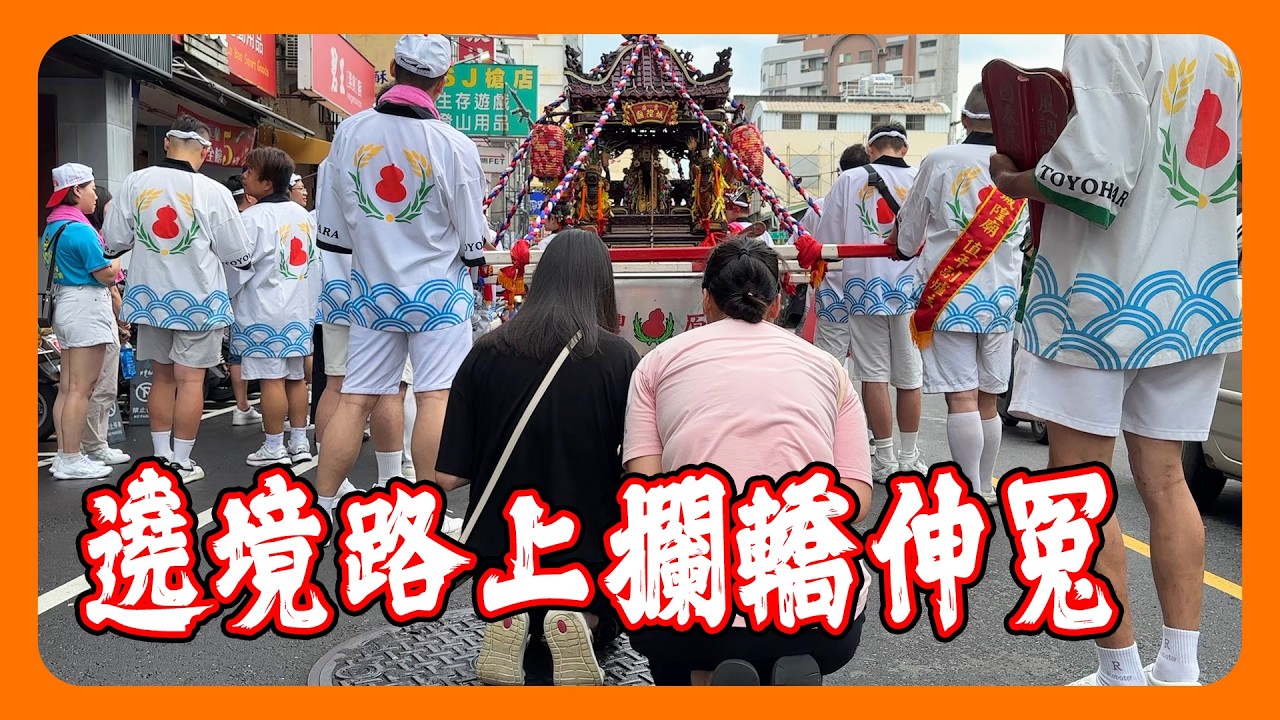
【迎熱鬧趣】今年跟著一起去嘿咻|2025年豐原城隍祭墩腳迎城隍|剛出發就有人攔轎伸冤|豐原迎城隍這頂轎好重阿! #城隍 #豐原
Highlight Reel The Pin-Yuan who sings “Xiao Wei” is the yellow one. The Pin-Yuan who documents Taiwanese stories… …is the orange one. Welcome back to the orange Pin-Yuan. Hey everyone, I’m Pin-Yuan. Before we start today’s show, remember to like, subscribe, and share. And give it a big push! Today, I’m taking you to Fengyuan’s… …Dunjiao City God Temple. The City God Temple is hidden in the market. Should we call this an alley? It’s the kind of place you’d walk right by… …if you’re not paying close attention. You wouldn’t notice the City God Temple tucked away in here. Today is the 14th day of the 6th lunar month. It’s the day before the City God’s birthday. The Dunjiao City God Temple has a century-old tradition. The day before the City God’s birthday, they hold a procession. So today, I’m here to document… …the Fengyuan City God Procession. As for a detailed introduction to the City God Temple, I talked about it in last year’s video. If you’re interested, you can check out last year’s video. After the group worship at 11, today’s procession will begin. Everyone is already getting ready. The Taitung City God is coming out. This is the Fengyuan Dunjiao City God Temple’s… …most unique Japanese-style palanquin. There are two small palanquins today. The one in front is Prince Nezha. And the one behind is the Great Sage. This is the Hsinchu City God. This is the one I recorded last year, the Zhong Kui who eats firecrackers. He really eats firecrackers! Look at his beard. This is the first time I’ve seen… …someone prepare this for a procession. This is probably for when you’re stuck in traffic or hiking. Something to use for the restroom. If you pee in it, it will solidify. Then you can throw it in the trash. Because this Japanese-style palanquin… …has a crisscross-shaped frame. It’s quite long. It can’t be assembled in the alley of the City God Temple. So they have to bring the palanquin out to assemble it. It’s more elaborate than I thought. Including this on top… I don’t know what this rope is called. It needs to be tied tightly. How many years have you been participating? First year. First year. Why did you decide to join? Because they held it last year. And I saw the photos. This year I’m the president of the general association. They invited me, so I came. So you guys are… …the Junior Chamber? So you’re all partners from the Junior Chamber. And they are… …the Fengyuan Junior Chamber. I’m with the Taiwan Junior Chamber. So there’s a difference. We’re the main association. They’re the local chapter. Actually, in the beginning… …this City God Temple festival in Fengyuan has been around… …for a hundred years. And up until now… …many of our young people in Fengyuan… …don’t even know about this festival. And since I’m involved with the City God Temple… …I know about the difficulties they’re facing. And the chairman is very open-minded. He welcomes the youth to come back… …and carry on this culture. So we looked for… …the largest youth organization in Fengyuan, the Fengyuan Junior Chamber International. To help us carry this Japanese palanquin from Fengyuan, this culturally rich Japanese palanquin, and lift it up. Now Teacher Ji is going to give everyone a pre-procession briefing. These young people are all partners from the Junior Chamber. Teacher Ji should be checking heights now. He said the heights have to be just right. So the palanquin won’t be tilted. And so some people won’t have to carry too much weight. One group has 16 people. A total of 16 people are needed to carry it. Now it’s time for a practice run. The sky doesn’t look very promising. It looks like it’s going to rain when we set off. What does “adjusting the sticks” specifically mean? Is it adjusting for height? Adjusting our heights. So the step we just did, “adjusting the sticks”… …was to adjust everyone’s positions. The heights have to be adjusted. Otherwise, the divine palanquin will be tilted and not straight. Sometimes it can be crooked. We just finished adjusting the staves, and now we’re back at the temple for group worship. We’ll set off after the group worship. There are children inside. This pair of Grand Masters is carried by children. I heard the divine generals have been specially designed. They’re made to be lighter. The Taitung City God is setting off. The Hsinchu City God is also about to set off. I think Zhong Kui will come to inspect the troops. Bringing out Zhong Kui’s sword. Taiping Mazu is about to set off. See my outfit? Today is for “hei-xiu” (chanting) with everyone. White pants, white shoes. Taiping Mazu is also in a vehicle. Carried by a float. Now the City God has ascended the palanquin. Once it’s secured, we’ll set off. The sky over there looks like… …it might be clearing up. Hope it really clears up and doesn’t rain anymore. Taiping Mazu is here. The one in charge of the patrol is the Fourth City God. It’s always him who goes on patrol. Legend has it that when the City God came to Taiwan, there were two City Gods in total. One was a civil City God, and one was a martial City God. The clay-molded martial City God… …was damaged during the sea crossing. So it was later remade into eight City Gods. If you look closely at the back of the attendant’s plaque, it says “Capital Prefecture City God.” This is because of a legend… …that the City God was a branch from the Fujian Provincial City God Temple. “Jing” (capital) represents the provincial City God. Which is the Civil City God. “Fu” is the Prefectural City God, which is the Martial City God. Which is the Martial City God. On top of our Japanese palanquin… …is an eagle. I heard it was originally a phoenix. It was a phoenix. Later it was changed to an eagle. Because an eagle is a bird of prey. More fierce. It’s for that imposing presence. When the City God comes out, it’s to vanquish demons and evil spirits. So the eagle’s presence is used. Someone is here to ask for the City God’s help. They have a grievance. They’re here to ask for the City God’s help. I can’t tell the whole story. Anyway, praying for the City God’s divine power to help. We’ve now arrived at Fengyuan Station. There seems to be some kind of event here at the station. There’s a stage here. It’s probably an event by the Junior Chamber of Commerce. The Fengyuan Junior Chamber of Commerce… …has organized a series of events. Guided tours and an opportunity for the public to experience carrying the palanquin. Now the City God is about to set off again. To officially begin today’s procession. I haven’t seen the other one yet. The women’s palanquin. Let’s go to the front and see. This is another Japanese-style palanquin. It’s made of stainless steel. It’s carried by the women’s palanquin team. The lantern on the palanquin… …for some reason, says “Izakaya.” This stainless steel palanquin… …is carrying the Yin-Yang Judge… …and the two generals, Cangue and Lock. This stainless steel palanquin… …is carried by the women’s palanquin team. Oh no. It suddenly started raining again. And the rain is coming down hard. Suddenly, it’s pouring. Even if it’s pouring, we have to keep going. So I’ve decided to put on my raincoat. There probably won’t be much footage in the rain. The Young Masters’ Association of the Yilan City God Temple. They are coming out with their divine generals. They have to keep going without raincoats. Actually, quite a few groups are participating today. It’s just that they’re walking ahead, so I didn’t see them. Because I’m following the City God at the very back. It’s probably because the alley of the City God Temple is too narrow. So the participating groups… …seem to be gathering in this parking lot first. Then, after the procession reaches here, they join in one after another. A few days ago, the Fengyuan City God Temple… …braved the wind and rain to support Huide Temple. Today, it’s Huide Temple’s turn to support… …the Fengyuan City God. I heard that the Hsinchu City God… …and the Fengyuan Dunjiao City God… …are brother temples. It’s recorded that since the Japanese colonial era, they have been participating in the City God procession. So, since the Japanese colonial era, they have been participating until now. It’s a century-old history. A century-old friendship. Finally, it’s the City God’s turn to set off. Because the procession in front is really long, so we just rested here for a while. The palanquin bearer’s uniform has a meaning. It has a meaning. In the middle is a gourd. Because Fengyuan’s old name is Huludun. The reason it’s red… …is because the City God Temple is built next to the Fire Gourd acupoint. So it’s a red gourd. This ear of rice, because during the Japanese colonial era, Fengyuan’s rice was very famous. It was offered as a tribute to the Emperor. So this is considered an industry of Fengyuan. This water… …refers to the Huludun Canal. Huludun Canal. So the entire design on this garment… …has its own meaning. Including what’s written on the side… TOYOHARA is the old name for Fengyuan. It’s “Fengyuan” in Japanese. There’s a household here preparing generals… …and an incense burner to welcome the procession. It seems like there are fewer incense tables from ordinary households. They are also fewer. Most of the incense tables now are from shops. Now resting on the side of the road. I don’t know why the front has stopped. Maybe it’s because we’re almost at Letian Temple. Besides the original palanquin bearers from the City God Temple, many today are from the Fengyuan Junior Chamber of Commerce. I see a special guest. Teacher KTGOGO. Because he had class this morning, so he’s only showing up now. Zhongfu Temple also has a palanquin out. Because they are the main patrons this year. Zhongfu Hall has also invited the Songjiang Battle Array. This is the firecracker that Zhong Kui is going to eat later. This person whose clothes are a different color from everyone else’s… …is Teacher Ji. He’s the leader of the palanquin bearers. He’s in charge of everything. The reason why Fengyuan City God Temple… …uses this kind of Japanese palanquin… …dates back to the Japanese colonial era. At that time, the Japanese didn’t allow… …us to have lively processions. So, as a compromise, we used Japanese palanquins. And they agreed to it. So it has been passed down to this day. We’ve always used this type of palanquin. I’d like to report to everyone, our TOYOHARA… …was during the Japanese colonial period… …when the Japanese came to our Fengyuan… …and discovered that our Fengyuan’s rice… …is of very good quality. The rice was offered as tribute to the Japanese imperial family. In Japanese, they named it TOYOHARA. It originated from the Japanese belief… …that between them and what we call heaven, there is a pure land… …called TOYOHARA. And in Chinese, it means… …the Land of Abundant Reed Plains and Fresh Rice Ears. So our Fengyuan logo… …is a gourd… …and a symbol of fresh rice ears. We’ve now arrived at Fengyuan An-Tian Temple. I just tried carrying it once. It’s surprisingly heavier than I thought. This palanquin is carried by 16 people, but it’s still very heavy. I don’t know if it’s because the height is uneven. So it’s very heavy. I hear we’re about… …halfway through the route. Next, we’ll visit Fengyuan’s Ciji Temple. The Mazu Temple. Time for an energy boost. There’s always a refreshment truck handing out drinks and food. Thanks to the boss for the sponsorship. We are now passing by the Huludun archaeological site. It’s actually a park, right? There is a Land God temple here. But the procession didn’t turn in. Let’s get ahead of the crowd. Let’s go to Fengyuan Ciji Temple to see the festivities. This stop is at Fengyuan’s main temple, Ciji Temple, dedicated to the goddess Mazu. The procession has now returned to Fengyuan Station. On the way, I ran into a currently popular author, Romantic Mountain Patroller. He’s really handsome. Time for KT to get to work. Get to work, KT. Get to work. Pushing like this… …shows that you’ve participated. Participation is what matters most. How long have you been serving the City God? It should be about ten years. Ten years. Are you a local of Fengyuan? I’m from Daya. From Daya. Why did you come all the way here? It was fate. And interest. Interest. I see, so you’re here for the lively atmosphere. At least I came to serve him. For peace and safety. Yes, yes, yes. The lights on the City God’s palanquin are on. Because it’s getting dark. So the lights are on. We’re preparing to return to the temple. The deities from the various friendly temples in front have returned. I’m troubled. My fans are all so young. They don’t even know who I am. The palanquin, immediately… The deity is invited in and the carrying poles are immediately removed. Today’s Fengyuan Welcomes the City God… …was a complete success. It’s a wrap! So tired. It’s not that I’m tired, but… …it was a lot of stopping and starting, and it was really heavy. Very heavy. It’s painful. Because that palanquin was heavier than I thought. It was still a very special experience. Thanks to their cultural team for giving us this opportunity. Thank you to the cultural team. for coordinating for us. So we could participate. So we’re really grateful to them. They are very dedicated to preserving the tradition. So there’s a series of events. Thanks to Fengyuan Dunjiao City God Temple. That’s all for today. Remember to follow and subscribe. Like and share. Turn on the little bell. Anyway, remember to subscribe to the Orange Pin-Yuan. And KTGOGO After Class.
2025年豐原城隍祭墩腳迎城隍
記錄時間:2025/7/8
時間好快又過了一年
我都還記得去年鍾馗爺吃炮畫面
馬上就又一年了
今年 @ktgogo88 突發奇想
也想穿上轎班衣服
所以我就硬著頭皮問問
感謝文化組協助讓我們能親身體驗
一起來去參加豐原迎城隍
跟豐原國際青年商會的夥伴一起嘿咻
章節大綱:
00:00 精采預告
03:12 神轎校籤
07:23 團拜出發
09:00 鍾馗爺調營
11:48 出發遶境
13:59 攔轎伸冤
15:02 抵達豐原車站
16:22 白鐵日式神轎
18:33 轎班衣服含意
21:21 KTGOGO報到
23:53 豐原的意思
24:30 KT扛轎
26:56 品源扛轎
28:12 抵達慈濟宮
33:21 準備入廟
Music by SunoAi
—————————————————-
橙色的品源 X 記錄在地生活
Facebook: https://supr.link/GTjFg
Instagram:https://supr.link/Xazf9
各平台分享內容會按平台性質有差異
歡迎追蹤分享
合作邀約
請私訊FB、IG或來信yake2434@gmail.com