
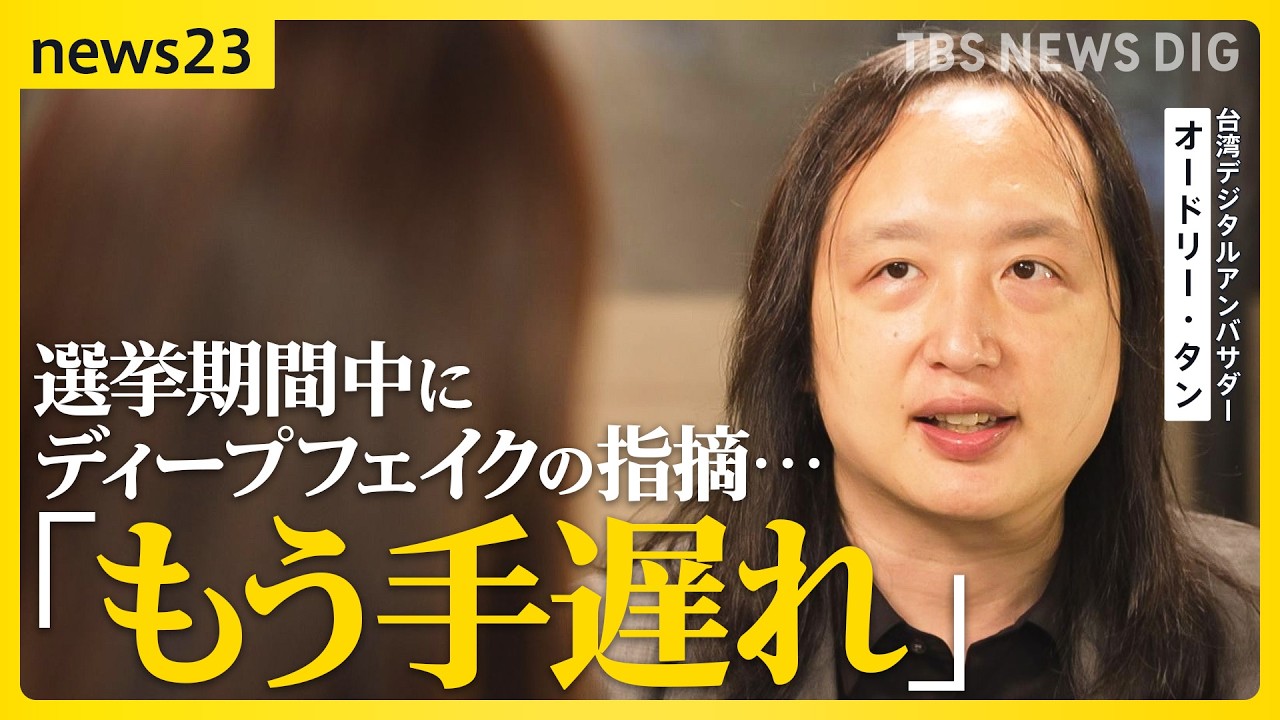
“ドラえもん”のように?テクノロジーと共存 台湾元デジタル担当大臣オードリー・タン氏が語るデジタルで分断を乗り越える未来 小川彩佳キャスターが単独取材【news23】
of better understanding of how AI models work the Asian So the more we see the conflict Hi you pleasure meeting you Nice to meet you My name is Hi I’m Audrey on life like it is like a documentary movie or something [Music] I’m so curious that you don’t carry smartphone with your like iPhone or Android Is that true But I carry a much larger It’s so large Why do you avoid using smartphones If I use touchscreen I feel addicted very easily But I vastly prefer uh the keyboard something I can type because it takes conscious action I cannot mindlessly scroll uh on a keyboard Don’t you feel unconvenient in those style Well nowadays it’s very convenient with uh the voice Ah okay So I can say “Hey Siri to control it.” Uh and it’s also still very intentional Oh I I am going to tell that to my four-year-old daughter cuz she’s like so stuck in the digital devices like smartphones Mhm Mhm Well I mean this is also a digital device It’s just very difficult to get addicted uh to it It’s just there to remind you once in a while M does keeping some distance from everyday tech um help you see it more clearly I think the point is that technology should not distract us So that for example I see you as a ve very vivid in reality but if I use my phone because the color there is even more bright than this color so I see that as even more real unless I turn it into grayscale using color filter in which case it’s slightly better and the reality actually is kind of grayscale right so by turning the phone into grayscale we restore the balance the touchscreen nowaday Okay Uh-huh They’re so bright so colorful too bright too colorful But by turning the screen in our phones into grayscale we restore the balance So the reality again is more vivid They can join a signal group and then the signal What is uh hard again is that um uh the when the fake news spread it spreads so rapidly and especially in election uh period and the fact check can’t just keep up and um some people might uh cast their votes based on the false information and it and it will be too late and when they discovered so uh what can we do to prevent those thing to Indeed uh in 2022 I deep faked myself and share it on social media showing that it’s coming that everybody can look like anybody else Because if you during the election see a deep fake spreading and say that’s deep fake it’s already too late But if two years before the election you already say the deep fakes are coming to the next election then everybody remember that And once they see the defect they don’t fall for it You can say for example that just because it looks like real it’s no longer real So now using AI tools uh everybody can make a painters’s impression of anybody else So anything we see no matter how lielike it is like a documentary movie or something like that it’s always a artistic impression And once we realize that then we go back to the old norm where we ask where does it come from We check the actor the behavior but we never believe something is true just because of the content And so that is the pre-bunking that’s needed to get into everybody’s vocabulary So how can we make the people do so to see it’s real or not So for example uh in Taiwan when we deliberated about deep fake on social media we sent message to 200,000 people asking them what they feel M the message come from 111 is a trusted number If you see it from 111 it came from the government Right So that is checking the source not the content And the people came together and make a law that said if you see Audrey Tong on Facebook trying to give you some crypto or something that’s fake The real one will carry the digital signature of Audrey Tong On the other hand if people can together find out what’s actually happening that is to say everybody learned the art of journalism which is about checking the sources balancing the sources having a good delineation between news stories and opinions Those very basic 101 thing you learn as a journalist If everybody learns that then we have inoculation We have immunity against the kind of polarization the kind of outrage and so on that is sold by those discord makers Misy [Music] big issue in Japan many young people feel disconnected to politics and voters turn out is low trust in institution is so um fragile and what do you think helps younger generation feel more included to politics and what’s been working well in Taiwan well when I was 15 I did the first work on the worldwide web with browsers and websites and so on to support the political campaign of a presidential candidate uh Chanuan Uh my dad was the spokesperson for that candidate He didn’t win by the way but I learned a lot uh participating in the political process We do see uh more people who are teenagers participating in the campaign for idea even if not the campaign for people So in Taiwan again the people who are teenagers middle schoolers they can go on the national platform and start petition and 5,000 people can force administerial response So for example the middle schooler petitioned to go to school one hour later because one more hour of sleep gets you a better grade than one more hour of study Uh they were very successful in affecting that change If you’re in your middle school era and then you effect change very effectively sometime you become our cabinet level advisor a reverse mentor even before you turn 18 you can advise our ministers on where the society is going and that is very powerful People feel empowered if they’re in a position to shape the societal agenda So the more we get the younger people younger than 18 set the societal agenda the better they will feel about democracy once they turn 18 If we exclude them from the democratic process not even setting the agenda not even campaigning for ideas then of course by the time they turn 18 they’re already very disconnected Um so is it is it a matter of um education or it is a matter of giving the power of setting the community agenda to the people who are even under 18 Uh they can be our reverse mentors shaping the direction of society that those idea go through effort [Music] One of the hardest thing today is that some people seem too deeply um rooted to the echo chamber and not only uninterested in dialogue but actively avoiding it So how would you reach our voice to those who shut themselves off and not willing to listen I would say that most people do not find it easy If you broadcast your idea to hundreds of millions of people it’s not uh natural because for most of us when I say something I see you nodding or you see oh maybe you need more explanation you check each other’s understanding This is called a conversational context Within the same context we can be sure our idea will not get misinterpreted that those idea go through However if you make a broadcast to hundreds of millions of people most of those people do not share the same context they can take the same words interpret it in a vastly different fashion and taking it out of the original intended meaning and then they will start dunking it or attacking it and so on making a caricature out of the original intention Instead we should have more like citizen assemblies or small amount of conversations among people who can see each other either online or in person maybe just 10 people But what if people won’t join the conversation with with um avoid joining the conversation What should we do So I wouldn’t say there’s one platform just go to that platform I say find the kind of platform that you are comfortable with and then uh discover the people who share your values even though maybe not exactly the same background but your values and then start a conversation together It can be as easy as just three or four people and it doesn’t need to expand The point here is that digital communities are best when they support each other across differences instead of dunking on each other because of differences M it’s not just online Um divides in the real world are growing too and especially in the United States for example we’re seeing rising hostility towards minorities and immigrants and how do you see this trend of global polarization and what’s your biggest concern I think for many people uh the idea of social differences by itself is not the problem But people rightfully fear that their tradition like spiritual tradition community tradition and so on will be forcibly erased by those people who practice different ideas So how about the transgender people They are having a very tough time in United States Mhm M well again I mean I can see uh where the people who are afraid of for example being forcibly uh told that their pronouns their way of using language and so on must be changed right so in a sense this is a reaction to the previous um ideas of uh kind of a radical uh reshaping uh of the language itself to me uh my pronouns are whatever uh you can call me whatever I I don’t really care I cannot get offended So I’m non-binary not just in gender but also in political ideology uh left versus right Uh I’m also non-binary uh in terms of like urban rural or different spirituality and things like that And so I don’t have in my mind half of the people are close to me and the other half of people are the other people the enemies or something like that And so to practice this non-binary thinking I think it’s important to understand where they are coming from and coming to a mutual understanding of how to resolve those practical issues instead of just ideological issues one by one We’re now living in a place where all the video all the content are artistic impression What is your ideal vision of the world through uh using technology I think my ideal vision is where technology aligns itself to society’s needs where the society holds the steering wheel of technology My job is called cyber ambassador Cyber comes from the Greek uh cybernetics uh which means to steer like steering a ship because in Silicon Valley we hear that there’s a very fast take off of AI coming super intelligence or whatever there’s people who say oh this takeoff is necessary we need to leave everybody behind because we need that to solve those important problem we also see people saying no the super intelligence itself is the big problem we need to stop It’s like saying the car should stop or you should get more gas into the pedal But the most important thing about the car is not just the stop or the gas pedal It’s the steering wheel If we can steer AI and other technology toward where the society wants instead of just the next biggest super intelligent thing then we can diffuse the technology in a way that is democratic that is defensive and also decentralized and then we will be able to see AI as normal technology and that is my sincere hope Do you think the world is uh going forward to that vision Well definitely I see Japan and Taiwan We think of AI and robots and so on Not as Terminator to be terminated but rather as Dora to coexist peacefully uh with people And part of the Dora ethics is that even though Dora have all sort of different tools they’re all opted in And once it’s uped in and doesn’t quite work that way uh then you can opt out So you don’t see uh the people in Dora those children uh locked into Tik Tok and just looking at Tik Tok every other episode You see the technology being introduced interact with society keeping just the good parts and doing away with the bad parts Again it’s like electricity It’s like the internet It is as normal technology Please enjoy the rest of your time in Tokyo Thank you
台湾で初めてデジタル担当大臣を務めたオードリー・タン氏が、新著書「PLURALITY」の出版に合わせて来日。
「news23」の単独インタビューに応じました。フェイクニュースが溢れる時代においての情報の見極め方、そしてデジタルは分断を乗り越える鍵となるのか聞きました。
★オードリー・タン氏の思想をもっと深く学べる映像
(約60分のCROSSDIGノーカットインタビュー)
▼TBS NEWS DIG 公式サイト https://newsdig.tbs.co.jp/
▼チャンネル登録をお願いします!
http://www.youtube.com/channel/UC6AG81pAkf6Lbi_1VC5NmPA?sub_confirmation=1
▼情報提供はこちらから「TBSインサイダーズ」
https://www.tbs.co.jp/news_sp/tbs-insiders.html
▼映像提供はこちらから「TBSスクープ投稿」
https://www.tbs.co.jp/news_sp/toukou.html
#ニュース #news #TBS #newsdig