
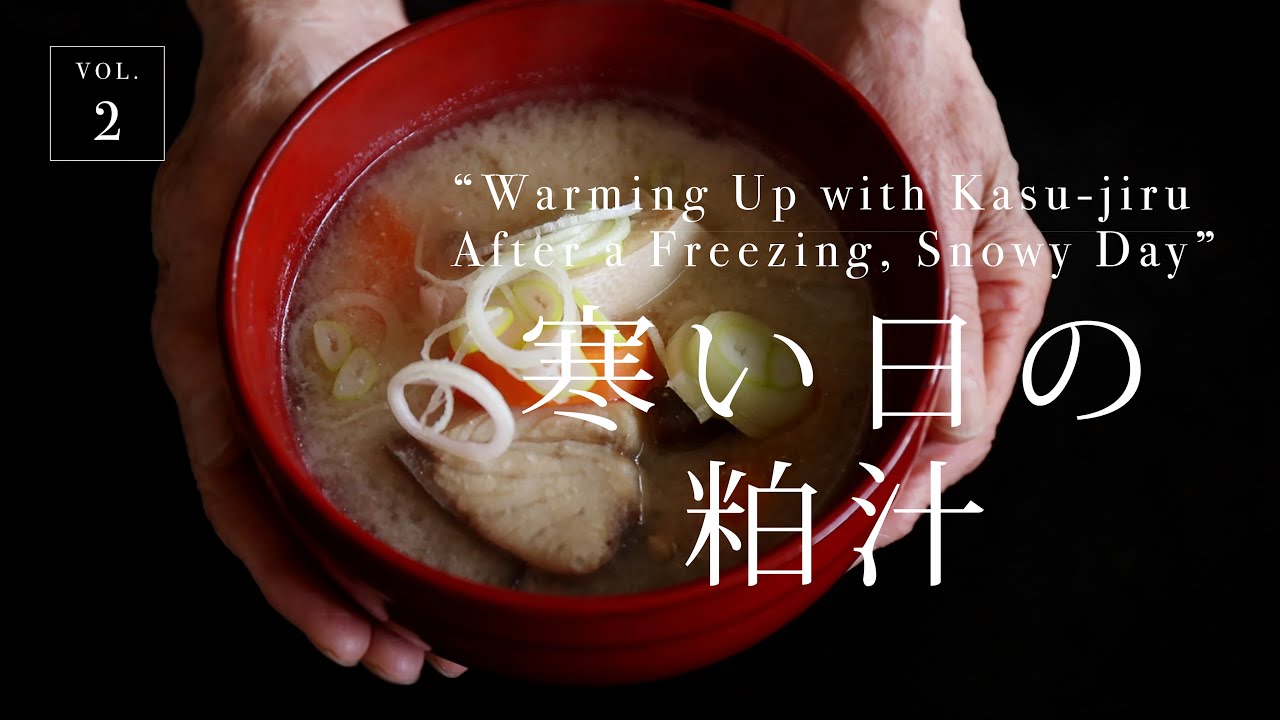
Warming Up with Kasu-jiru After a Freezing, Snowy Day,
Have you ever tasted Kasu-jiru, a traditional Japanese soup?
The key ingredient in Kasu-jiru is Sakekasu (sake lees).
Sake lees are a by-product of sake production.
When making sake, various ingredients, including steamed rice, are fermented to create a mash called Moromi.
The liquid extracted from this mash becomes sake, and the white solids left behind are the sake lees.
When sake lees are pressed into solid sheets, they are called Itakasu (sake lees in sheet form). These are commonly found in Japanese grocery stores. However, my personal favourite is Nerikasu (paste sake lees), which has a looser, paste-like texture, softer than miso.
Nerikasu is made by allowing sake lees to undergo a slow re-fermentation process, resulting in a creamy and tender consistency.
My favourite is Daiginjo Sakekasu from a sake brand called Kikuhime.
Sake lees contain about 15g of protein per 100g, which is equivalent to the protein content of 100g of natto or 80g of beef.
Sake lees are rich in Koji mold and yeast, as well as various vitamins, making them a nutritious fermented food.
A bowl of Kasu-jiru made with seasonal Yellowtail (Buri) and plenty of root vegetables warms you from the inside out, leaving your hands and feet feeling toasty.
Kasu-jiru is a comforting dish that fills both your stomach and your heart, making it perfect for cold days.
—————————————————————–
Yellowtail and Root Vegetable Kasu-jiru (Sake Lees Soup)
Ingredients (serves 4)
– Yellowtail (Buri) – 1 slice from the belly and 1 slice from the back
– Daikon radish – 1/2 (or 1/3 of a large one)
– Taro root (Satoimo) – 3 to 4 pieces
– Carrot – 1/2
– Shiitake mushrooms – 4
– Spring onion or thin leek – to taste
– Kombu dashi (kelp stock) – 1 liter
– Sake lees (Nerikasu – smooth paste-type) – about 1/2 cup
– Miso – about 1/3 cup
Preparation
– Kombu dashi: Soak a 10 cm piece of kombu (I use Rishiri kombu) in plenty of water and leave it in the fridge for at least one night.
– Yellowtail: Lightly salt both sides of the yellowtail and leave it in the fridge overnight to draw out excess moisture, then pat dry before using.
– Daikon radish: Peel the daikon thickly and cut it into 1.5 cm thick half-moon slices. Boil the daikon in plenty of water with a pinch of salt. Boil until a bamboo skewer can easily penetrate the daikon, then drain. You can store it in the fridge for about a day.
Instructions
1. Place the kombu-infused water into a pot, removing the kombu beforehand.
2. Peel and slice the carrot into 5 mm thick half-moon pieces. Remove the stems from the shiitake mushrooms, make a slit in the caps, and tear them into 4 pieces vertically, including the stems.
3. Peel the taro root and wipe away any dirt or slime with a paper towel. Cut it into bite-sized pieces.
4. Slice the yellowtail into 2 or 3 pieces, trimming the thickness with a slightly angled knife.
5. Heat the dashi in a pot and add the carrot. Once it begins to boil, add the taro root, then the yellowtail and daikon radish. Continue to simmer until the carrot and taro are tender, then add the shiitake mushrooms.
6. Once it comes to a boil again, dissolve the sake lees into the soup, followed by the miso. Start with a small amount of sake lees and miso, taste, and adjust as needed. The flavour may vary depending on the type of sake lees and miso you use, so be sure to taste and adjust the amount accordingly.
7. Slice the spring onion into thin rounds. Serve the finished kasu-jiru in bowls and garnish with the spring onion.
Note on Kombu:
I often use kombu for various dishes like Kobu-jime (kelp-cured sashimi), so I buy long pieces of kombu from a kombu specialist shop. I store them in their long form in the pantry and take out only what I need. I wrap it in a damp cloth and let it sit for a while to soften. Then I cut it to fit the container and add plenty of water to make kombu dashi by soaking it in the fridge.
—————————————————————–
Feel free to ask questions, share your thoughts, or leave any comments for Yoko in the comment section.
7 Comments
料理の茶道のような美しさ
そろそろ寝すもうかしらと思っていた時に、動画の通知を頂きました。今日一日頑張ったご褒美ですね✨️
明日は粕汁であたたまりたいです。これも寒い日ならではの楽しみですね✨️
ずーっと恋する瞳で拝見しました❤ありがとうございます😊
なんて美しいお鍋なのでしょう。
Beautiful!
酒粕大好きなのですがあまり好みでなかったり、美味しくてもどこで買ったのか忘れたり…笑
安定しなかったのですが同じもの調べて購入してみました♡
届いたら同じレシピで粕汁作ろうと思います♨️楽しみです😊
Merci pour ce magnifique tableau d hiver, votre approche est belle et delicieuse à la fois ❤