
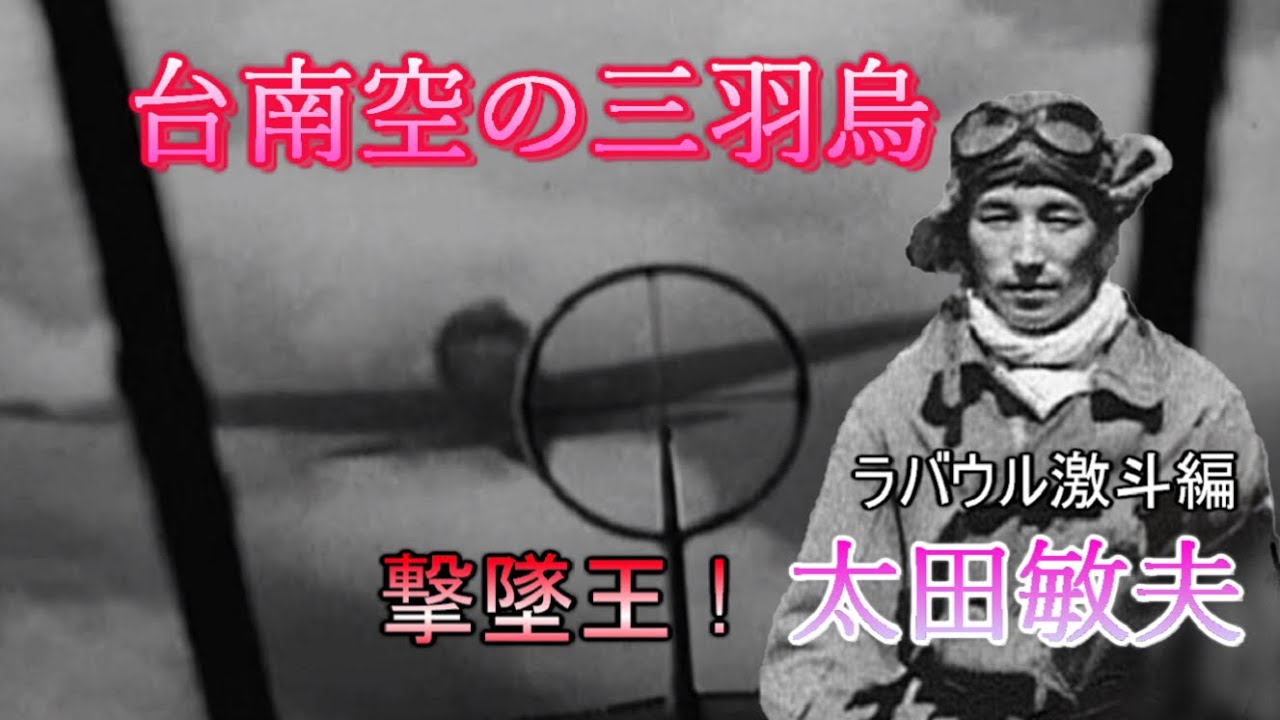
台南空の三羽烏 撃墜王!太田敏夫 ラバウル激斗編
April 20, 1942 (Showa 17) The special aircraft carrier Kasuga Maru, whose main mission is to transport aircraft, dropped anchor off the coast of Buka Island and brought a beautifully painted new Zero fighter. The Tainan Naval Air Corps crew received their long-awaited aircraft on the Kasuga Maru.
Until then, there were only 12 old Type 96 battleships and worn-out Zero fighters, but 24 new Zero fighters were deployed in Tainan Air Corps. The receipt of the new Zero was the prelude to a full-scale attack on Port Moresby. Flying Ace Toshio Ota
Lieutenant Colonel Kozono, vice commander and flight commander of the Tainan Air Corps, orders daily sorties when a new aircraft is deployed, calling it “daily maintenance.” Ota’s number of sorties and number of shootdowns increased rapidly. April 26th Port Moresby attack mission
Ota was formed as the 2nd platoon leader of the 7-plane escort zero squadron of the Port Moresby First Attack Force. 6:00: Led by Lieutenant Kaoru Yamaguchi, the landing force and the assault force depart for Port Moresby. The attack force entered the airspace over the enemy airfield without being intercepted.
The ground attack force began the attack, and the Zero Squadron patrolled the surrounding area with air superiority patrols. 7:00: After confirming that there were no enemy interceptors, Lieutenant Yamaguchi ordered a ground attack and destroyed three parked aircraft.
After one sweep of the ground, The Yamaguchi squad confirmed the approach of five P-40s. It became a melee between 7 aircraft and 5 aircraft. In a fierce air battle, Yamaguchi’s team shot down three aircraft, four were hit, and Ota was unharmed and jointly shot down one aircraft. 8:40am All aircraft returned.
April 29th, 7:00 AM: Three B-17s from the 19th Bomber Squadron of the U.S. Army attack Lae base. Ota, who had no plans for a sortie, jumped into the Zero and pursued the fleeing enemy plane,
Repeatedly attacking for more than an hour, and succeeded in shooting down a single Flying Fortress, which had seriously injured him in January. May 2nd Port Moresby forced reconnaissance air superiority mission Ota, who became a first sergeant, was organized into Sasai’s 9-Zero 2nd platoon and 2nd aircraft.
Commander Lieutenant Sasai graduated from flight school less than half a year ago, but his ability to accept advice from non-commissioned officers showed his true potential. He was increasing his individual kills as well as his unit kills at an astonishing rate. 5:25: Lieutenant Sasai heads out of Lae leading many Flying Ace.
Shortly after, Chief Petty Officer Watari, the 1st aircraft of the 2nd platoon, a master of single-machine combat, returned due to mechanical problems, and the 2nd platoon was led by Ota. After crossing the Stanley Mountains, the Sasai team passed over Port Moresby at an altitude of 5000m.
At 6:30, They turned around at sea and found his two formations, a B-17 and an escort plane heading to attack the Japanese base, and a B-25 and an escort plane, totaling 15 planes. Lieutenant Sasai thrust his 1st and 3rd platoon into one group, and Lieutenant Sasai and Ota’s 2nd platoon into another group.
After the first shot as a greeting, Ota got behind the second enemy aircraft and shot it down. The Zero Squadron had an advantage in the air battle against the enemy, who had broken ranks, and Sasai’s unit shot down eight aircraft, including one belonging to Ota, but lost Airman 1st Class Kasai.
May 7th: Tainan Air Force launched 11 Zero fighters under Major Nakajima into the Battle of the Coral Sea. The Nakajima squad searched for the enemy beyond its limits, and all of its aircraft made an emergency landing on Gasmata, New Britain Island, and were unable to influence the naval battle.
US and Australian troops in the direction of Port Moresby The Australian military stationed coast watchers in various locations, and it was not uncommon for interceptors to be waiting for them.
However, the experienced aircrews of Tainan Air Corps were quick to detect enemy aircraft, and it was not uncommon for battles to begin with surprise attacks. The fighter planes of the US Army and Australian Forces deployed to Port Moresby were mostly P-39 Aira Cobras and P-40s, which Tainan Air Corps calls Katsuobushi.
The Zero fighter, operated by an experienced crew and with excellent acceleration, was good at mid-altitude melee battles with both heavy and immovable fighter planes, and was shot down repeatedly. May 25th: Tainan Air Command received information from captured enemy pilots about large-scale replenishment of Port Moresby.
And planned “daily maintenance” to gradually reduce enemy aircraft the next day. On May 26th, Ota conducted air patrol over Lae from 5:30 to 7:10, and was organized into Kawai’s 16 aircraft, the second aircraft of the 2nd company commander, Lieutenant Sasai. 9:45am Departed on attack mission to Port Moresby
At 10:20, Kawai’s team confirmed enemy shadows over the Stanley Mountains, and the enemy, who had replenished, was aiming at the Japanese military base with four B-17s and 20 P-39s. Captain Kawai changed his strategy and signaled an attack on the enemy formation, and the Zero Squadron attacked all at once.
The Kawai squad, made up of Ota, Lieutenant Sasai, Flight Sergeant Major Miyazaki, Flight Sergeant Nishizawa, and Flight Sergeant Sakai, shot down five P-39s with all aircraft undamaged. Ota and Lieutenant Sasai shot down one aircraft and drove off the enemy formation. May 27th Port Moresby attack mission
Tainan Air Command deemed the previous day’s encounter insufficient and ordered 27 Zero fighters led by Captain Masao Yamashita to carry out daily attacks. Ota was organized into the 3rd company, Sasai unit, and Lieutenant Sasai’s 2nd aircraft. sortie at 8:50
10:05: Infiltrated the air above the enemy base, and about 30 aircraft including Spitfires and P-39s were waiting ahead. Yamashita’s team rushed into the enemy, went on a rampage, shot down 7 aircraft, shot down 2 aircraft, and finished the battle with all aircraft intact. 10:30 left the battlefield
After the war, according to Saburo Sakai’s recollections, The three men known as the Three Crows of the Tainan Sky, 1st Petty Officer Sakai, 1st Petty Officer Ota, and 1st Petty Officer Nishizawa, left the company after the attack on Port Moresby.
Returning to the skies above Seven Mile Airfield and performing three consecutive formation somersaults with three aircraft in formation. Martin Kadin, co-author of Mr. Sakai, claims to have heard eyewitness accounts from American soldiers who were in Port Moresby at the time.
However, according to the combat action report, the three men were organized into different companies and all aircraft returned to Lae at 11:30. Mr. Sakai’s anecdote about naming Sanba Karasu as a strongman in the Tainan sky does not seem to be true. May 28th Port Moresby attack mission
6:10: Ota departs for a three-day attack on Port Moresby as the commander of the 3rd platoon of the 26-plane 1st company led by Major Nakajima. The Spitfire engaged a total of 20 P-39s, shot down two P-39s unharmed, and all returned base.
June 1st: Petty Officer Gitaro Miyazaki, who fought illness to take part in the attack on Port Moresby, was hit by a surprise enemy bullet and exploded in the air.
Flying Ace from the 12th Air Corps to Tainan Air Force was scattered to Rabaul. 13 aircraft shot down, platoon results 44 shot down, 37 air battles Battle of Midway June 5, 1942 Japanese and American aircraft carrier forces clash around Midway Island.
The Japanese Navy suffered a major defeat, losing four aircraft carriers and nearly 300 aircraft, and air and sea supremacy tilted heavily toward the American side. The Imperial Headquarters’ attempt to capture Port Moresby was thwarted in the Battle of the Coral Sea.
After losing the Battle of Midway, they gave up on capturing the Fiji Islands and Samoa Islands (FS Operation), but they aimed to “cut off the US and Australia” by using Guadalcanal in the Solomon Islands as a replacement for the lost aircraft carriers.
Rabaul, a key location for the capture of Port Moresby, grew in importance as a base for her capture of the Solomon Islands, and Rabaul was supported by the sea, land and air forces, including the Tainan air force, called the Rabaul Air Corps.
In mid-June, the US and Australian forces established a support system for Port Moresby, with weekly reinforcements of pilots and about 30 fighter planes. On the other hand, the Tainan Air Corps made repeated sorties day after day against an unrelenting enemy.
While the number of aircraft shot down by Ota and his crew increased, only a few aircraft were replenished on rare occasions, and the number of aircraft that could be used in actual service was around 20. Even if maintenance is carried out by excellent maintenance personnel, a fully operational Zero fighter is worn out.
A valuable aircraft that could not be lost could not be entrusted to inexperienced crew members, and the experienced crew members were burdened with fatigue. Since the beginning of the war, Lieutenant Sasai was the only officer left, and the NCOs who had made a name for themselves were disappearing one by one.
Although air superiority was maintained in the Rabaul area, no progress was made in the capture of Port Moresby. As a way out, they began researching ways to conquer the area by land, and on July 21, they began constructing a landing airfield in Buna to use as a base for the attack.
August 4th reconnaissance plane cover mission At 8:30, Ota departed from Rabaul as a squad leader of four Zero fighters escorting one reconnaissance plane, and at 12:00, he discovered a new enemy airfield in Ravi where fighter jets had begun advancing.
General MacArthur, who was unable to carry out a counteroffensive operation from Port Moresby with just a plan, began construction of Ravi as a forward base prior to Japan’s advance into Buna. The escort detaches the reconnaissance plane and launches a ground attack.
Engaging with 11 P-40s that took off after setting three of them ablaze, Ota shot down two of them by himself, leaving the four Zero fighters unharmed. The reconnaissance plane, which continued to search for enemy airfields, never returned after witnessing an encounter with two P-39 planes that appeared from somewhere.
The Japanese military in Rabaul also needed to respond to the Allied forces’ new base Rabi, which was under construction. August 6th: The 2nd Air Corps, which strengthens Rabaul’s air power, arrives in Rabaul with 15 Zero fighters and 16 naval bombs.
The following day, August 7, just before Ota’s Zero Squadron was scheduled to depart from Rabaul to the new airfield Buna, an enemy fleet appeared off the coast of Tulagi and captured the newly completed Japanese naval airfield on Guadalcanal Island.
Upon receiving the report, the Japanese military headquarters in Rabaul immediately held a strategy meeting and planned an attack on the enemy fleet by a complete land attack of the 4th Air Squadron, escorted by Tainan Air.
Ota was organized into the 3rd company of 18 aircraft led by Major Nakajima and the 2nd aircraft under Lieutenant Sasai. 7:50 AM 27 ground attack aircraft from Tainan Air Corps and 4 air forces depart from Rabaul.
One of the planes, which had trouble with its retraction gear, soon turned back, and the 17 Zeros headed southwest, about 1,000 km one way, with 27 land attack planes. 11:10am, 3 hours and 20 minutes after departure
The Zero Squadron noticed many sunspots in the sky above Guadalcanal Island on their right, Sabo Island in front of them, and Tulagi harbor in the back, so they sped up.
The enemy was waiting for about 80 aircraft, including many F4F Wildcat fighters, said to be excellent aircraft from the early stages of the war, and this being the first battle against them.
The Zero Escort Squadron rushed into the enemy aircraft that was standing in its way, running through the enemy and trying to attract the enemy aircraft.
However, some of the enemy forces, which were more than 4 times larger, attacked the land attack force heading for an anti-ship attack, and the land attack force suffered heavy damage from enemy attacks and anti-aircraft fire.
Ota did not leave Lieutenant Sasai’s side and repeatedly attacked, downing two F4Fs alone and two together, but Tainan Air lost three. 1 hour from the start of the battle 12:10pm Leave the battlefield Ota, who had finished his engagement with the pursuing enemy aircraft, had shot off most of his ammunition.
15:30: The first group of 11 aircraft returned to Rabaul. Even if the flight went smoothly after a fierce battle, it would have taken 3 hours and 20 minutes.
1st Petty Officer Sakai, who was the last to return to Rabaul, misidentified an enemy ship-based bomber formation over Guadalcanal Island on his way back, let his guard down, and was hit by a bullet in the right front of his head.
1st Petty Officer Sakai was given treatment on the mainland, and another veteran left Rabaul. August 8th-9th Battle of Savo Island.
The Japanese Navy launched a night attack on the American and Australian fleets off the coast of Guadalcanal and Tulagi, and achieved a great victory by sinking four enemy heavy cruisers with almost no damage in the “one-pass attack”.
The remaining enemy fleet, which suffered heavy damage, canceled the landing and temporarily evacuated from the coast of Tulagi. Tainan Air Force, which had suffered losses during operations in the Solomons direction, temporarily finished supporting Guadalcanal Island in 10 days and proceeded with operations in the New Guinea direction.
August 11th: Tainan Air Force attacked the enemy’s new airfield, Ravi, which they had discovered but were unable to touch, with a ground attack force. Ota sortied as the 2nd platoon commander of Sasai Company.
At Ravi, six aircraft from Sasai’s squadron engaged in a fierce dogfight in which three were hit and one crashed into the water, but Ota suffered one P-40 shot down alone, one shot down jointly, and one undetermined loss. returned unharmed
August 20th: 19 F4F and 12 SBD aircraft entered the Guadalcanal Island Airfield, named Henderson Airfield, and began operating it as an air base. Japanese forces in Rabaul resumed attacks on the Solomons from the following day, the 21st, in order to prevent American air superiority centered on Guadalcanal Island.
Furthermore, Tainan Air Force, unable to ignore the New Guinea area, jointly advanced to Buna on August 22nd with a detachment and some of the Zero fighters of the 2nd Air Corps. August 23-24 Battle of the Eastern Solomons The Japanese Navy lost one aircraft carrier and failed to transport troops to Guadalcanal.
Meanwhile, the American military landed supplies and reinforcements on August 25, the day after the naval battle, and the outcome of the Battle of Guadalcanal was determined by logistics. August 26th Guadalcanal attack force cover mission
6:43: Nine Tainan Aircraft, commanded by Lieutenant Sasai, departed for Guadalcanal to escort the ground attack force, with Ota out of the formation. Three Zero returned by 2:45 p.m. Three Zero returned late, but three did not return. One of them was Lieutenant Sasai.
Although there are records of Tainan’s admiration for Lieutenant Sasai, who did not return, and the statements of several members, there is no record of the suicide of Ota, who shared many aerial battles with Sasai.
Tainan air operations continued over a wide range from Rabaul and New Guinea to Solomon, and the battle with the enemy was intensifying.
Up until now, there had been a small number of aircraft shot down or not returned to Tainan, but the number has increased, the number of aircraft and crew has decreased, and joint operations with other fighter squadrons have increased.
The war against the United States had lost its momentum immediately after the war started, and the future was beginning to look bleak, but the fighter pilots in Tainan’s airspace were cheerful and their morale was high despite the hardships. September 13, 1942 Guadalcanal reconnaissance cover mission
4:30: Nine aircraft led by Captain Kikuichi Inano escorting two reconnaissance aircraft sortie for forced reconnaissance. Ota was the 3rd platoon, with 1st Petty Officer Oki as the 2nd aircraft, and 3rd platoon as 3rd Flight Sergeant Kazushi Hato, who had just turned 20 and had shot down 19 aircraft.
At 8 o’clock, he entered the skies over Guadalcanal, and several of his F4F20s were waiting in front of him. Inano’s Squadron separated their reconnaissance planes and hit more than twice as many enemy planes, shooting down 8 planes in a fierce dogfight.
Ota jointly shot down two aircraft with 1st Flight Sergeant Oki, but the young shot-down king, 3rd Flight Sergeant Hato was hit by enemy bullets and blew himself up, Inano’s Squadron lost 4 aircraft.
After successfully completing reconnaissance during the battle and returning, the reconnaissance team reported the expansion of Henderson Airfield and the increase in equipment and strength.
After the American army landed on Guadalcanal, the Japanese army attempted to retake Henderson Airfield, but due to transportation obstructions, they were unable to land sufficient forces, and the landing force was destroyed one after another. The Imperial Headquarters plans an all-out attack with enhanced amphibious forces in late October.
The Rabaul Air Corps, which supported operations such as maritime air patrols and attacks in the Solomons, continued to work hard. October 15th Guadalcanal Island landing fleet air patrol mission
Ota was organized into a joint fighter squadron, the 3rd company of 17 Zero fighters, and the 2nd platoon commander, and departed from Buka at 6 o’clock.
Shortly before 8:30, close to 100 enemy aircraft and the advance Zero Squadron were engaged in a melee over the Japanese convoy in front of Ota, which was approaching the rendezvous point. The 3rd shift company abandoned its tank and increased its speed, breaking into the melee at 8:30.
The Zero Squadron lost 6 aircraft but shot down 25 aircraft including uncertain ones, Ota shot down 1, joint shot down 1, and severely damaged an F4F. Despite the success of the Zero Squadron, the Japanese fleet suffered heavy damage and the transport to Guadalcanal Island ended up being insufficient.
October 18th: Guadalcanal Island attack, land assault force escort mission Ota was formed as the second aircraft of Lieutenant Takeyoshi Ohno. 7:00 6 Tainan Aircraft and 3 3rd Air Corps aircraft sortie Shortly after, Lieutenant Ohno turned back due to a malfunction, and at 10:30, the eight Zero fighters entered the airspace over Guadalcanal.
10:45: There was an air battle with 20 F4F aircraft, and 5 aircraft were shot down. Ota alone shot down 2 aircraft, but 1 aircraft did not return. October 21st Guadalcanal Island attack land attack support mission
5:40: Escort group of 12 Misawa Aircraft ground attack aircraft, Lieutenant Ohno’s second aircraft, departs from Rabaul with 13 Zero fighters, 9 Tainan Aircraft and 4 2nd Aircraft. Lieutenant Ohno invaded Guadalcanal Island at an altitude of 6000m.
9:10: Leaving six aircraft from the 2nd and 3rd Platoon to escort the ground attack force, the three aircraft from the 1st Platoon (Lieutenant Ohno, Flight Sergeant Hajime Ota, and Airman Hajime Saito) took the lead and entered the skies over the enemy base.
9:15am: 17 F4F aircraft from the US Marine Corps’ 212th Air Wing appeared from Henderson Airfield to intercept the aircraft. The 1st platoon dives into the enemy, and in the melee Ota shoots down Warrant Officer Tex Hamilton, an ace who shot down seven aircraft.
During this time, he was backed up by Lieutenant Frank Drury, who was assisting Warrant Officer Hamilton at Thatchweave. Before Ota could tear the enemy away, he was shot, and his flying hat flew into the teardrop-shaped windshield.
The Ota plane, spewing black smoke, disappeared into the Guadalcanal jungle, following the parachute of Warrant Officer Hamilton, who had escaped from the F4F that had been shot down earlier.
The 1st platoon, which engaged in an air battle with 17 aircraft with 3 aircraft, had no hits on the 1st and 3rd aircraft, and all of the ground attack squadron and escort aircraft returned with the exception of Ota.
After moving to Rabaul, Ota’s aircraft was hardly hit by bullets at the front line, where replenishment was difficult, and there was no damage to the aircraft.
During the formation of the 2nd aircraft, Ota devoted himself to supporting the 1st aircraft, and he was proud of the fact that he had never lost his 1st aircraft. Looking back on Ota’s last sortie, Lieutenant Ohno of the 1st plane said that Ota may have been his substitute.
Ota’s war experience has been less than 11 months since his first battle. Six months after moving to Rabaul, the number of sorties was 61 and the total number of aircraft shot down exceeded 36. Toshio Ota, Naval Flight Chief Petty Officer, died at age 23
The Tainan Naval Air Corps, to which Ota had belonged since its inception and which had made a name for itself as the core of the Rabaul Air Corps, lost many of its aircraft, the treasures of the Japanese Navy, and many of its skilled crew members.
November 1, 1942: 10 days after Ota was destroyed, the Tainan Naval Air Corps was reorganized into the 251st Naval Air Corps and ceased to exist. Thank you for watching my video.
ラバウル航空隊の中核、台南海軍航空隊 熟練搭乗員 撃墜王 太田敏夫!
参考文献
『台南空飛行機隊編成調書』(防衛研究所図書館所蔵)
郡義武『坂井三郎『大空のサムライ』研究読本』、光人社、2007年
坂井三郎『大空のサムライ・完結篇-撃墜王との対話』(光人社NF文庫、1975年)ISBN 4769823924
ヘンリー・サカイダ『日本海軍航空隊のエース1937‐1945』小林昇訳(大日本絵画、2000年)ISBN 4499227127
秦郁彦・伊沢保穂著『日本海軍戦闘機隊 戦歴と航空隊史話』大日本絵画、2010年。
外山操編『陸海軍将官人事総覧 海軍篇』芙蓉書房出版、1981年。
John B. Lundstrom 『The First Team and the Guadalcanal Campaign: Naval Fighter Combat from August to November 1942 』(Naval Institute Press、1993年) ISBN 1557505268
15 Comments
台南海軍航空隊 万歲😊🎉
台南空というと小園安名さんが有名だけど隊員たちからオヤジと慕われていた斎藤正久大佐についても詳しく紹介して欲しいね。
ポートモレスビーの三機同時宙返りですが、坂井氏の著書では後に米軍が台南空所在の基地に来襲し連絡投下筒を落とした。
そこには御三機の次なるご挨拶を待っていると、敵基地司令官の文書があった。
そう記憶しています。
笹井中尉の件は太田さん、いや誰でも帰還後には言えなかったと思います。
少なくとも対米国との不利な状況下での戦争。
南冥に散った英霊の皆様に対し、政府は口頭でもって感謝の意を伝えるべきです。
ラエは男の゙行く所
最前線基地。
太田敏夫氏、本当にご苦労様でした。お疲れさまでした。永遠に日本人の記憶にとどめましょう。それにしても、日本側の戦闘機数があまり増えないのに対して、アメリカ側はどんどん増えて行く。いつも二倍、三倍の敵と戦えば、どんな撃墜王でも不意を突かれて被弾する。被弾がゼロ戦にとって命取り。最後、撃墜した敵機のパイロットが落下傘で降下というのが、機体の頑丈さの違いを物語っている。熟練搭乗員が次々にいなくなる事態に、何も抜本的な対策も講じられなかったのか。
みんな騙されて散って行ったね、、、 戦後の服部卓四郎、辻政信、源田実、岸信介、石井四郎、、手のひら返しの上層部は、アメリカGHQべったりで銭をもらってたけどな。
太田飛行兵曹長の戦歴がわずかに11ヶ月という事を、初めて知りました。台南空の活躍は坂井三郎氏の「大空のサムライ」。海兵出身の艦爆操縦員豊田穣氏の「蒼空の器」などで読みましたが、太田敏夫氏は「ベテランパイロット」だと思っていました。ラバウル進出後の6ヶ月で出撃61回、撃墜36機。驚くばかりです。私には母方の伯父が二人おり、陸兵としてガダルカナルの飛行場付近の戦闘で負傷し、昭和17年ラバウルの兵站病院で亡くなった長男と、昭和20年6月伊江島上空で戦死した零戦搭乗員の次男の方がいます。皆様に合掌。そして、今の日本の危機(安倍元首相の暗殺、LGBT 理解促進法の強引な成立、WHO保健規則の改定によるコロちゃん枠ちゃんの義務化など、日本を混乱させ衰退させる状況など)に対処して行かなければならないと思いました。
【スピットファイアとP-39合わせて約30機が待ち構えていた】
・・・残念ながら此の時期には「スピットファイア」は配備されておらず「誤認」ですね。
台南空がラバウルに進出した頃は、日本海軍が攻撃側で勢いがあった。しかし戦果報告は過大に成り勝ちであり、急降下離脱も「撃墜」と誤認したケースも多かったから報告した数字を鵜呑みにはできない。
戦後暫くして、坂井三郎氏にインタビューした識者が「此の時期にスピットファイアは(ポートモレスビーに)配備されていない」と記録を元に指摘しても、「俺達ベテランが見たから間違いない」と頑なだった。其の記事を読んだ私は「ベテランと称する者」でも「こんなものか?」と白けてしまった覚えがある。
【一方の台南空は衰えない敵に連日の出撃を繰り返し】
「太田敏夫」が活躍した此の時期は連合国側も非常に苦しい時期で、補給に関しても地図を見れば一目瞭然だが、補給線は日本より米国の方が遥かに長い。しかも米国大統領は「対ドイツ」欧州戦線を優先し、太平洋方面は「後回し」する意向だったから、太平洋方面作戦部長キング大将は補給物資の確保に苦慮していたそうだ。
こんにちは😊
こんにちは😊
343空の隊長の筆頭だった鴛淵孝大尉と故郷がほぼ同じ、長崎出身の寡黙で好青年な太田敏夫。
西澤と坂井三郎は自他ともに認めるワルガキなのに、太田は貴公子然とした好青年。
ただファイティング精神は抜群でB17を徹底的に追い回し撃墜して帰ったり不時着した事もあると聞きます。
ガダルカナル戦で行方不明、戦死認定ですが遠距離飛行で疲労して墜死したと推測です。
零戦隊は一旦引換し、ルンガ沖で太陽を背にしたF4Fサザーランド中隊の奇襲を受けています。吉田素一飛曹はサボ島海岸?で機体の残骸が発見され、太田敏一飛曹はドルーリー中尉に
上昇反転中に撃墜されたらしいです。
台南空戦闘日誌には、5月27日の交戦した、戦闘機は、スビットファイアでなくP39を間違えものとの解説あり❗️私の記憶が正しければ、ニューギニア戦線には、スビットファイアは、投入されていないと思われる❗️スビットファイアが投入されたのは、オ―ストラリアのポ―トダ―ウィン❗️コ―ドウェル中佐率いる33機と、202空飛行隊長鈴木実中佐率いる零戦27機と交戦した❗️ときは、1943年5月2日である❗️伝承零戦第一巻 秋本実編参照
ガダルカナルへの連日の長距離飛行は過度な疲労を負わせたのは当然。いくらベテランでも、疲労、レーダーによる倍以上の敵機の待ち伏せ奇襲、使い物ならない無線機、携行弾数少ない20ミリ機銃、破壊力が無い7ミリ機銃での交戦、撃ち落したと思われた敵からの逆襲、防弾力の皆無、無事に帰れたのが奇跡みたいな連日の出撃行だった。
無事に戦闘区域から逃れても、長距離の帰航中に疲れて居眠りしてしまい、そのままスィーっと海面に落ちて行った機がかなり有ったと聞く。起こしてやろうと追尾して無線しても無線機は効かず、墜落するのをただ見届けるしか無かったとか。激戦をかいくぐった歴戦の戦友がそんなことで簡単に命を落とす事に居た堪れない思いが有った事が想像に難くない。